
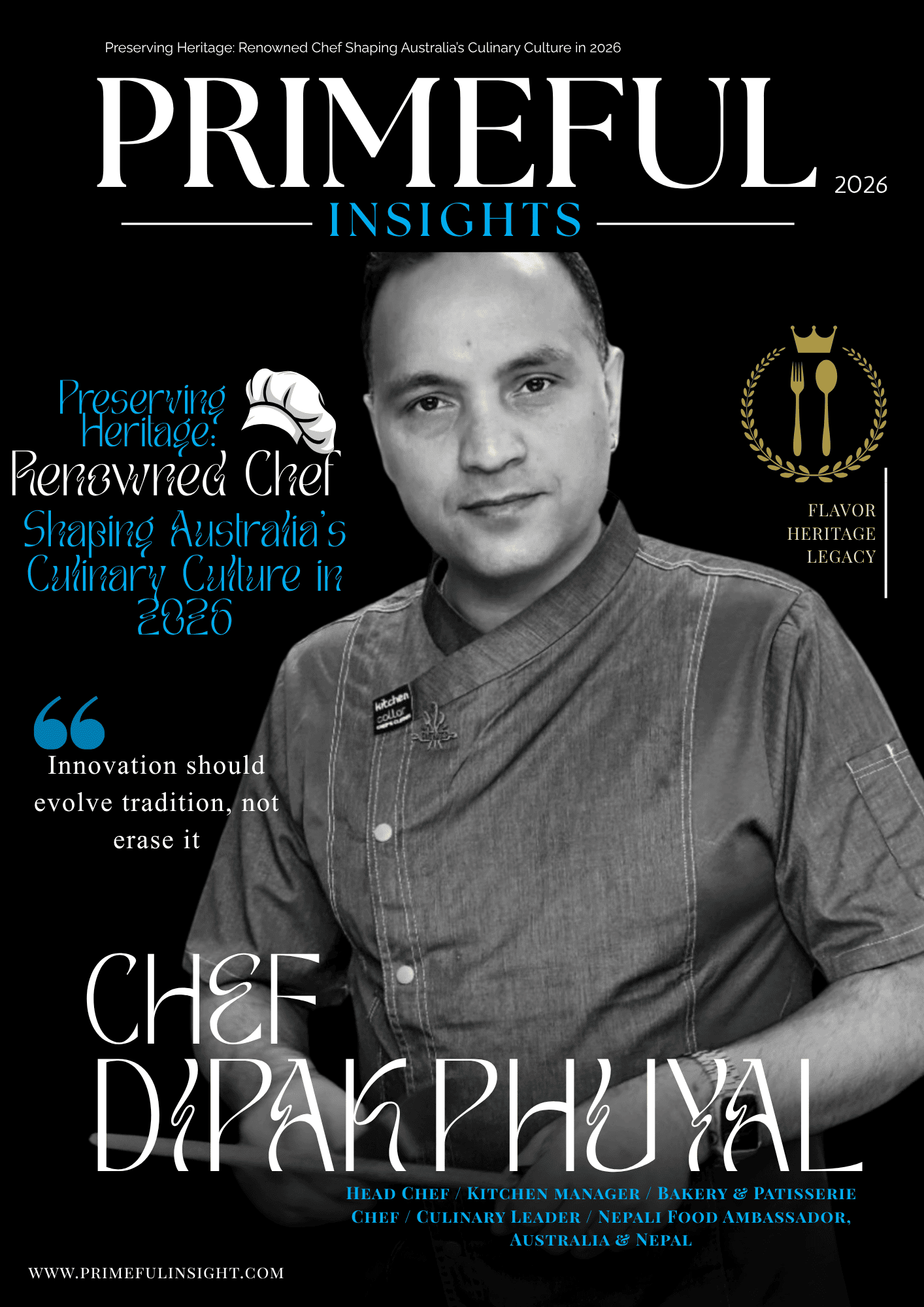
From Nuwakot to Adelaide: How Chef Dipak Prasad Phuyal Is Preserving Heritage While Shaping the Future of Hospitality
For Chef Dipak Prasad Phuyal, food has never been simply about what appears on a plate. Long before he entered a professional kitchen, he understood food as a way to bring people together, share culture, and create memories. Growing up in Nuwakot, Nepal, he watched community kitchens come alive during gatherings and celebrations. He was fascinated by the teamwork, traditional techniques, aromas, and ingredients that made these occasions special.
That early connection became the foundation of a career spanning more than seventeen years across international airline catering, hotels, fine dining, pubs, Italian and Greek kitchens, cafés, bakeries, healthcare, and aged care. Today, he serves as Head Chef and Kitchen Manager at AnglicareSA in Adelaide, South Australia, where he combines culinary knowledge with leadership, discipline, and a strong focus on the people he serves.
His journey to this position was not straightforward. Before entering professional kitchens, he studied mathematics, worked in finance, and later became a mathematics teacher. In 2009, he moved to Australia as an international student and began a new chapter that required resilience, patience, and a willingness to start again.
Today, his expertise extends across both commercial cookery and baking. His professional qualifications include a Certificate III in Commercial Cookery, Certificate IV in Kitchen Management, Diploma of Hospitality Management, Certificate III in Baking, and Food Safety Supervisor certifications in New South Wales and South Australia. His experience with breads, pastries, and desserts has also strengthened his understanding of precision, temperature control, texture, ingredient balance, and consistency.
Beyond the kitchen, Phuyal is a passionate advocate for Nepali cuisine. He serves as a Nepali Food Ambassador and Authorised Representative of Chef Nepal, Nepal’s first Nepali food reality show, in Nepal. He is also associated with the International Nepalese Chef Society (INCS Global).
For Phuyal, culinary excellence is about more than creating great food. It is about leadership, learning, culture, discipline, and creating memorable experiences for the people he serves.
A Defining Decision to Start Again
Phuyal’s professional journey began with an important realization: passion does not always follow the career path we initially imagine.
Although his education and early professional experiences were rooted in mathematics and finance, his connection to food never disappeared. The memories of growing up around community kitchens in Nepal stayed with him, as did the sense of connection he saw in the way food brought people together.
Moving to Australia gave him the opportunity to explore that passion professionally, but the transition was challenging. As an international student, he had to adapt to a new country, unfamiliar systems, financial pressures, and life far from home.
During those early years, Phuyal worked on farms in rural areas while managing his studies and living expenses. The work was physically demanding, but it taught him valuable lessons about hard work, humility, and resilience.
Those lessons stayed with him when he entered hospitality at the most basic level.
His first culinary position was as a kitchen hand, where he washed dishes, cleaned, prepared ingredients, and assisted experienced chefs. He did not see the position as a setback. Instead, he saw it as an opportunity to learn.
He watched others, asked questions, practised new techniques, and took every task seriously. Over time, the kitchen hand became a cook, the cook became a chef, and the chef became a leader.
The experience taught him an important lesson that continues to shape his career: no honest work is beneath you, and every experience has something to teach.
A Career Built Through Every Kitchen
Over more than seventeen years in hospitality, Phuyal has worked in environments that required very different skills.
International airline catering taught him about precision, organisation, and consistency on a large scale. Hotels and fine dining strengthened his understanding of presentation and service. Working in Italian and Greek kitchens exposed him to different cooking styles and traditions, while cafés and bakeries helped develop his skills in baking and pastry.
His experience in healthcare and aged care added another important dimension.
In these settings, food is not only about taste and presentation. Nutrition, food safety, dietary requirements, comfort, and dignity are equally important. A familiar meal can remind an older person of home or family. A favourite flavour can bring comfort and make mealtime something to look forward to.
Working in aged care has therefore changed the way Phuyal understands the role of a chef. He believes the responsibility begins with understanding the person receiving the food.
That perspective continues to influence his work at AnglicareSA, where quality and consistency matter, but so do empathy and care.
Leadership Through Service
Phuyal’s approach to leadership has been shaped by the same principle that guided his early career: remain willing to learn and help others grow.
He does not define leadership through authority or position. For him, it is about service, respect, accountability, and leading by example.
“Leadership for me is not about authority. It is about service, respect, accountability, and leading by example.”
That philosophy shapes the way he builds and manages teams. He believes a successful kitchen should never depend entirely on one person. A leader’s responsibility is to share knowledge, create opportunities, encourage responsibility, and help team members become more capable.
This becomes especially important in demanding kitchen environments, where chefs have to manage time pressures, food safety, dietary requirements, budgets, quality, and service at the same time.
Phuyal believes leaders should set the standard through their own behaviour. If a leader expects punctuality, they should demonstrate it. If they expect high standards, they should maintain those standards themselves. If they expect respect, they should give it.
For him, leadership is ultimately about helping the people around you move forward.
Innovation Without Losing Tradition
For Phuyal, innovation does not mean leaving tradition behind. He believes the two can work together.
His commitment to Nepali cuisine is a strong example of this philosophy. Growing up in Nepal gave him a deep appreciation for the cultural meaning behind traditional food. Dishes such as Thakali Khana and Newari cuisine carry generations of knowledge, identity, ingredients, and history.
The challenge, he believes, is to preserve that identity while allowing Nepali cuisine to evolve.
Modern presentation, cooking techniques, nutrition, sustainability, and changing dining preferences can all contribute to the development of traditional cuisine. What matters is that the original culture and meaning are respected.
The goal is not to change traditional food simply to make it different. It is to introduce it to new audiences while keeping its identity.
As a Nepali Food Ambassador and someone involved with Chef Nepal and INCS Global, Phuyal sees an opportunity to help more people discover the diversity of Nepali cuisine.
He wants people to understand not only the food itself, but also the stories, ingredients, techniques, and traditions behind it.
Learning From Every Experience
Continuous learning has been one of the strongest themes throughout Phuyal’s career.
Every kitchen, colleague, customer, challenge, and new technique has given him something to learn. His qualifications in commercial cookery, kitchen management, hospitality management, and baking reflect that commitment, but he believes learning goes far beyond formal education.
A new colleague can teach something. A difficult service can teach something. A mistake can teach something.
For Phuyal, a chef should never stop developing.
That mindset has helped him move across different areas of hospitality while continuing to build his skills. It has also influenced the way he works with younger professionals, encouraging them to remain curious and open to learning regardless of their position.
Lessons Forged Through Challenges
Starting over in a new country was one of the biggest challenges Phuyal faced in his career. Leaving behind family, familiarity, and his previous environment required courage and adaptability.
The early farm work taught him resilience. Starting as a kitchen hand taught him patience. Moving into leadership taught him that managing people requires emotional intelligence as much as technical knowledge.
Today, he understands that running a successful kitchen involves much more than cooking. Food safety, budgets, dietary requirements, quality, communication, teamwork, and accountability all have to work together.
When something goes wrong, Phuyal prefers to focus on learning rather than blame.
Instead of asking only who was responsible, he believes leaders should ask what went wrong, what can be learned, and how the same problem can be prevented in the future.
This approach allows mistakes to become opportunities for improvement.
His journey has taught him that challenges do not necessarily define a career. How a person responds to them can be far more important.
The Meaning of Success in Aged Care
For Phuyal, success is not defined by a job title alone.
In hospitality, success can be measured through awards, restaurant reputation, presentation, customer numbers, or financial performance. These things have value, but Phuyal believes there is another measure that matters just as much: impact.
His experience in aged care has made this especially clear.
A meal that meets nutritional requirements is important. But a meal that also creates comfort, brings back a memory, or gives someone something to look forward to has a different kind of value.
That is why Phuyal focuses on quality, consistency, food safety, teamwork, communication, accountability, and continuous improvement.
Developing people is equally important. He does not want to build a kitchen that depends entirely on his presence. He wants to create a strong team that can maintain high standards together.
For him, success includes the satisfaction of the people being served, the strength of the team, and the knowledge passed on to future generations.
Preparing for the Future of Hospitality
Phuyal believes hospitality will continue to change as technology, sustainability, nutrition, personalisation, cultural authenticity, and customer expectations evolve.
Technology is already influencing areas such as ordering, inventory management, food safety monitoring, production planning, and decision-making. Phuyal sees these developments as useful tools, but he does not believe they will replace the human side of hospitality.
Cooking is still about people.
Empathy, creativity, communication, and understanding the needs of those being served will continue to matter, regardless of how advanced kitchen technology becomes.
Nutrition will also become increasingly important, particularly in healthcare and aged care. Chefs will need to understand dietary requirements, texture modification, nutritional needs, and the relationship between food and wellbeing alongside flavour and presentation.
Sustainability will also require greater attention. Reducing food waste, using ingredients responsibly, improving supply-chain practices, and making better use of local and seasonal produce will become increasingly important.
At the same time, Phuyal believes Nepali cuisine has an opportunity to gain greater international recognition.
Nepal has a rich and diverse culinary identity shaped by regional traditions, distinctive ingredients, flavours, and cultural history. As diners become more interested in different cuisines, Phuyal believes Nepali food can reach wider audiences without losing its authenticity.
The future of hospitality, in his view, will belong to those who can combine innovation with tradition, technology with human connection, and professional excellence with genuine care.
Developing the Next Generation
For Phuyal, the future of hospitality also depends on the people entering the industry.
Technical skills are important, but they are only part of what makes a successful professional. He believes humility, curiosity, discipline, consistency, communication, and respect are equally important.
His own journey from kitchen hand to Head Chef has taught him the value of understanding every level of the profession.
He encourages young chefs not to become discouraged by starting at the bottom. Every role provides an opportunity to learn. Every kitchen can teach something new.
He also believes strong leaders should never feel threatened by talented people around them. Instead, they should help those people grow.
When team members become stronger, the whole organisation becomes stronger. The people being served ultimately benefit as well.
For Phuyal, empowerment is not simply something a leader talks about. It is something a leader puts into practice.
A Future Rooted in Heritage
Phuyal’s ambitions for the future extend beyond his own career.
He wants to continue developing as a chef and leader while mentoring young hospitality professionals. After more than seventeen years in the industry, he wants to share what he has learned and help younger chefs understand the importance of patience, discipline, resilience, and continuous learning.
He also wants to contribute to the preservation and international recognition of Nepali culinary heritage.
For him, promoting Nepali cuisine means more than serving traditional dishes. It means helping people understand the stories, ingredients, techniques, and cultural significance behind them.
He plans to continue expanding his knowledge across culinary arts, baking, food science, nutrition, leadership, and hospitality management. For Phuyal, education does not end when a qualification is earned. Every stage of a career brings another opportunity to learn.
He hopes his legacy will be measured through the chefs he mentors, the teams he strengthens, the people he serves, and the culture he helps preserve.
His story began in the hills of Nuwakot and led him to professional kitchens across Australia. Nepal gave him his roots, while Australia gave him the opportunity to grow and build a career.
He remains grateful for both.
His vision for the future is grounded in the same values that have guided him from the beginning: keep learning, keep serving, keep mentoring, and keep creating food that tells a story.
For Chef Dipak Prasad Phuyal, the kitchen is more than a workplace. It is a place where he can share his culture, develop people, and serve others through food. His journey shows that leadership does not always begin with a title. Sometimes it begins with being willing to learn, doing the work in front of you, respecting others, and improving with every experience.
And perhaps that is the simplest way to understand his philosophy: good food brings people together, but the people behind it are what make the experience meaningful.