
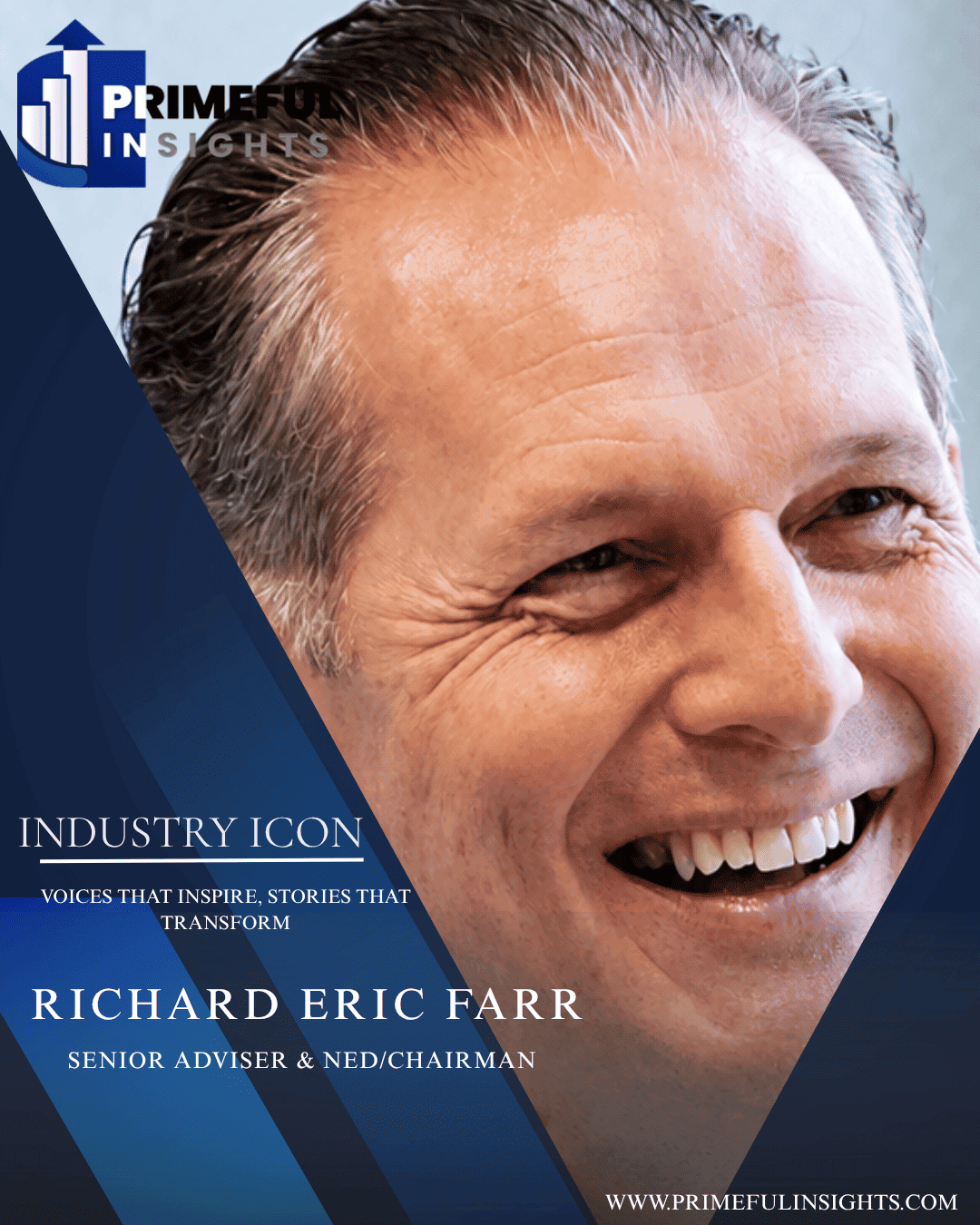
Building What Comes Next: Richard Eric Farr on Leadership, Judgement and Strategic Thinking
Richard Eric Farr, B.Com (Acc), FCA, FIFT, has built his career around a simple but demanding question: what is the right decision when the answer is not obvious?
More than four decades into his career, that question still shapes the work he does today. Through senior advisory and board roles across organisations including ArdentIQ Limited, Financial Freedom, Goldbach Capital, Ely Place Partners, MeltX, Mercer, Brightwell Pensions, Solomon Global and Elizabeth Xi Bauer, Richard remains involved in businesses, investments and complex financial situations where sound judgement matters.
His work today spans pensions, corporate finance, restructuring, risk transfer, covenant advisory, alternative assets, investment, start-ups and emerging financial ventures. He continues to advise, invest, build and work with businesses dealing with the intersection of capital, regulation, commercial reality and human behaviour. Richard does not see these areas as separate chapters of his career. The entrepreneur who built businesses, the adviser who worked through restructurings, the pensions specialist who helped shape industry frameworks and the investor assessing new ventures all reflect the same approach: understand the problem, question the assumptions and build something that works in reality.
“A scheme’s funding position isn’t abstract,” Richard explains. “It’s the retirement security of thousands of real people, sitting directly alongside a sponsoring employer’s own survival.”
That understanding of consequence has shaped the way Richard approaches decisions, builds businesses and advises stakeholders. For him, financial strategy is not simply about getting the numbers right. It is about understanding the people, incentives and circumstances behind them.
From Building Businesses to Solving Complex Problems
Richard’s career did not begin in pensions. He qualified as a chartered accountant and initially built and ran businesses across sectors including motor retail, IT services and money broking. Those early experiences gave him something that would become increasingly valuable as his career developed: an understanding of what decisions look like from the other side of the advisory table. Running a business means making decisions with incomplete information, limited resources and competing priorities. The consequences are not always easy to predict. A theoretically perfect answer is of little use if it cannot be put into practice.
That practical understanding eventually led Richard into corporate advisory and restructuring, and from there into the pensions sector.
At PwC, he became a Partner and Lead Pension Corporate Advisor. He later founded and led Swiss Re’s UK pension risk transfer function before becoming a Pension and Restructuring Partner at BDO. His career subsequently developed into specialist defined benefit covenant advisory at Cardano. Each role added to his understanding of complex financial decisions. The underlying challenge, however, remained much the same: how do you reach a workable outcome when different stakeholders have different responsibilities, priorities and ideas of success?
Judgement Before the Answer
Richard believes complex decisions are rarely difficult simply because the mathematics are complicated.
“The hardest decisions rarely fail because the analysis was wrong,” he says. “They fail because someone moved before the incentives of every stakeholder in the room were properly understood.”
That principle has influenced his approach to pension funding negotiations, restructurings, refinancing, de-risking transactions and investment decisions. A trustee may be focused on member security. A sponsoring employer may be concerned about its ability to keep operating. A lender may focus on downside protection, while investors may be assessing return and liquidity. The same facts can therefore lead different stakeholders to very different conclusions. For Richard, understanding those perspectives is not a secondary part of the process. It is part of the analysis itself.
It also explains why he is comfortable with uncertainty. In complex situations, the right answer is not always clear at the beginning. It may emerge only after several possibilities have been considered, assumptions challenged and less workable options ruled out. Richard sees that uncertainty as part of developing sound judgement, not something that needs to be hidden.
Building Frameworks That Can Withstand Reality
Some of Richard’s most significant professional contributions have gone beyond individual transactions.
He has advised organisations including the Pension Protection Fund and the Pensions Regulator on frameworks associated with the development of the UK pensions system, including work around the PPF’s early approach to insolvency risk and the Pensions Regulator’s original Clearance Guidance. That kind of work requires a different way of thinking. Advising one client means understanding a particular set of circumstances. Developing a framework that can influence an entire industry means thinking about situations that may not yet exist and considering how different participants might respond.
The experience left Richard with a principle that still guides his work:
“Good frameworks, whether a regulatory rule or a deal structure, have to be stress-tested against the worst-behaved plausible actor, not the best-behaved one.”
He applies that thinking by looking at both book-ends and counterfactuals. What happens if conditions deteriorate? What happens if incentives change? What happens when someone acts rationally in their own interests but in a way that challenges the intention of the structure?
For Richard, good thinking begins by considering those possibilities instead of assuming everything will go according to plan.
The Next Great Pensions Challenge
That mindset is particularly relevant to one of the areas Richard finds most compelling today: decumulation.
For decades, the pensions industry focused heavily on accumulation, helping people build retirement savings. Increasingly, attention is shifting to the more difficult question of what happens when those savings need to become retirement income. How should investment risk and longevity risk be balanced? How can individuals have flexibility without giving up security? How can solutions be delivered at scale while remaining understandable, affordable and fair?
“Decumulation, without question,” Richard says when asked which emerging area interests him most. “It sits at the intersection of almost everything else.”
The scale of the opportunity is significant, but so is the complexity. Pension providers need to consider regulation, capital structures, reinsurance, technology, behavioural factors and member outcomes.
For Richard, that makes decumulation more than another emerging trend. It represents a change in the way the pensions industry needs to think about its purpose. It is also a problem that is still being worked out, which is precisely the kind of challenge that interests him.
Asking the Question Behind the Question
Richard brings the same thinking to his work with alternative assets, including private equity, infrastructure and credit.
When an investor is deciding whether to hold or sell an asset, he does not begin with price. He starts with two questions: Do you still believe in the asset? And do you need the liquidity?
The distinction matters.
An investor may still have strong conviction in an asset but need liquidity because of changing portfolio requirements or wider financial pressures. Equally, an investment that once made sense may no longer justify its place in the portfolio. Separating those questions can help investors avoid selling good assets for the wrong reasons or holding poor investments simply because there is no immediate pressure to exit. It reflects a broader principle that has run through Richard’s work: before answering the question in front of you, make sure you understand the question that actually needs to be answered.
From Established Institutions to New Businesses
The entrepreneurial side of Richard’s career has remained active. Alongside his advisory and board responsibilities, he has invested in and worked with start-ups, joint ventures and emerging financial businesses. What attracts his attention is not simply whether an idea solves an interesting customer problem. He also wants to know whether the founders understand the environment in which that idea has to operate. In financial services, regulation, licensing, governance, capital and trust cannot be treated as issues to deal with after a product has been designed. They are part of the product itself.
Richard is particularly interested in entrepreneurs who understand that distinction. It brings together two sides of his experience: the entrepreneur who knows what it takes to build something new, and the adviser who has seen how quickly an attractive idea can run into problems when regulation, capital structures or stakeholder interests are considered too late.
That combination continues to shape how he looks at the businesses and opportunities he encounters today.
Complexity as an Education
After more than four decades, Richard does not advise young professionals to seek the easiest assignments. His advice is almost the opposite:
“Get close to complexity early, and don’t be afraid of situations that look messy.”
Straightforward transactions can teach technical skills. Ambiguous, multi-stakeholder situations teach something harder to acquire: judgement.
He also believes professionals should not allow specialisation to become confinement.
“The people who’ve had the most durable careers in this industry are rarely the narrowest specialists,” he says. “They’re the ones who kept learning the parts of the business next to their own.”
His own career reflects that philosophy. Accountant, entrepreneur, corporate adviser, restructuring specialist, pensions adviser, risk-transfer executive, covenant specialist, investor and board adviser are not separate identities so much as different parts of the same willingness to keep learning.
His most concise advice perhaps captures it best:
“Don’t stay in your lane but be prepared to be humbled.”
The second part is just as important as the first. Breadth without humility can become superficial, while expertise without curiosity can become outdated.
Still Building What Comes Next
The financial services landscape is entering another period of change. Decumulation, technology, evolving regulation, new investment structures and changing expectations are creating opportunities as well as new layers of complexity. For Richard, this is not simply a new chapter to watch from the sidelines. It is another set of problems to work on, businesses to help shape and opportunities to assess. His career has repeatedly taken him toward situations where commercial reality, financial structure, regulation and human behaviour meet. Those same interests continue to inform the businesses he advises, the investments he considers and the emerging ideas he explores today.
The lesson is not that complexity should be celebrated for its own sake. It is that important problems rarely become simple just because someone wants a simple answer. Understand the stakeholders. Understand their incentives. Ask what problem is actually being solved. Test the assumptions. Consider what happens when things go wrong. Then build something that can survive contact with reality.
That is the approach Richard has carried from entrepreneurship into advisory work and from established institutions into the businesses he continues to help shape.
After more than four decades, he remains focused on the same fundamental challenge: turning complexity into judgement, and judgement into something that works.