
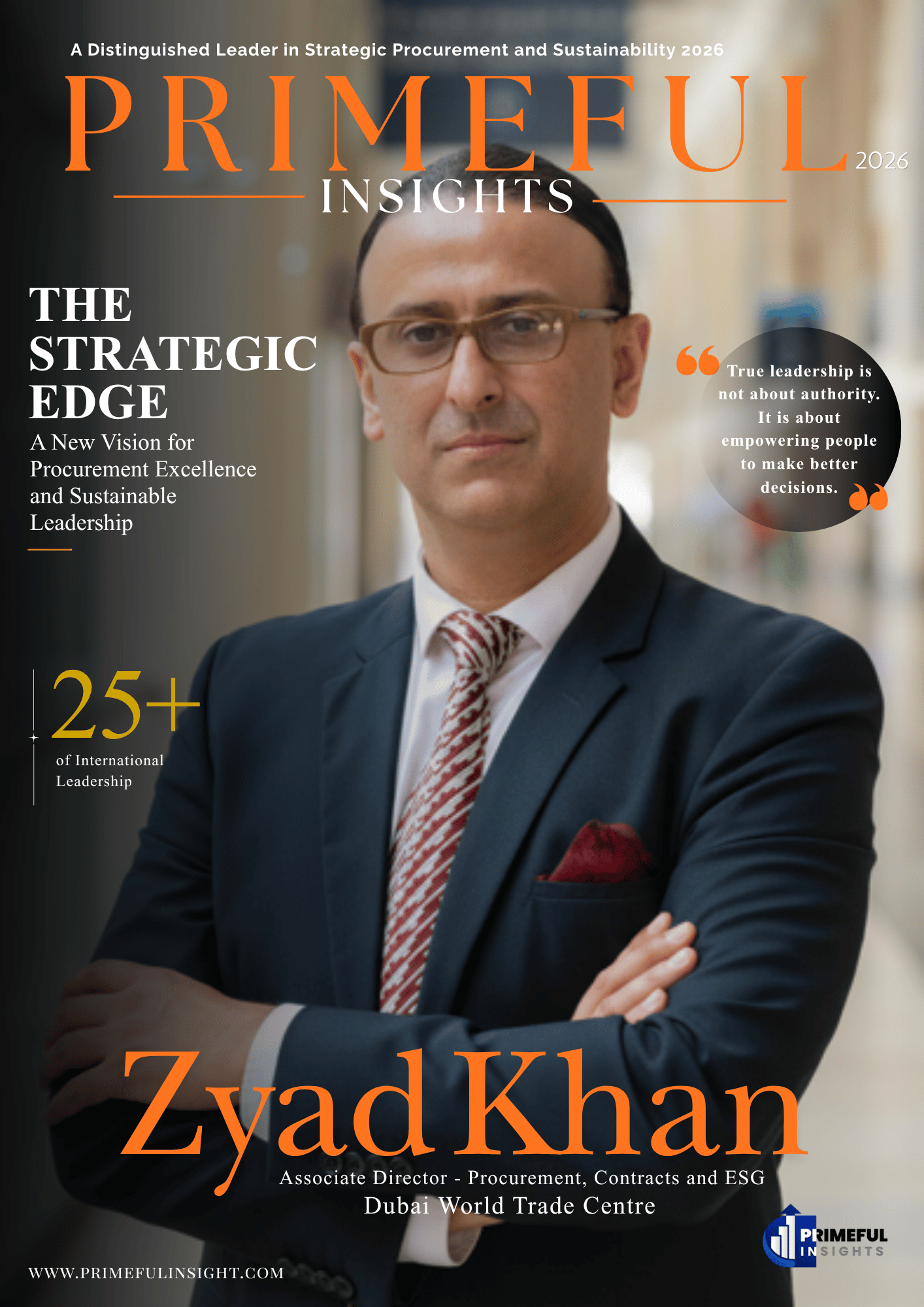
Beyond the Transaction: Zyad Khan on Strategic Procurement, Sustainable Leadership, and Creating Lasting Value
With more than 25 years of international experience across aviation, government, corporate enterprises, and major global events, Zyad Khan advocates a broader view of procurement, one that connects commercial performance with resilience, sustainability, and the people behind every decision. Every significant business decision has consequences beyond its immediate financial value. A supplier selected today can influence operational continuity tomorrow, while a contract negotiated under pressure can determine how well an organisation respaonds to disruption. Even routine purchasing decisions can shape customer experience, environmental impact, and the livelihoods of businesses across a supply chain.
For Khan, this is precisely why procurement belongs at the heart of business strategy. As Associate Director of Procurement, Contracts & ESG at Dubai World Trade Centre (DWTC), he has spent more than 25 years working in environments where commercial judgement must go hand in hand with operational understanding, sound governance, and an ability to anticipate change. He sees procurement not as a function that simply controls spending, but as one that can influence how an organisation performs and prepares for what lies ahead.
https://www.linkedin.com/in/zyad-khan-fcips-procurement-leader-esg-advocate-1131879
His career began almost by accident in the late 1990s, when he entered the field through retail. What started as an opportunity developed into a profession shaped by increasingly complex responsibilities, international exposure, and a growing conviction that procurement could contribute far more than cost savings. His experience with Emirates, the Private Office of the Ruler of Dubai, and Dubai World Trade Centre has reinforced a central principle: procurement delivers its greatest value when it understands the business it serves and helps shape what that business can achieve. For Khan, the profession’s progress depends on better decisions, stronger relationships, and outcomes that hold their value over time.
From an Unexpected Beginning to a Broader Purpose
A career does not always begin with a clearly defined ambition. Sometimes, its direction emerges through the opportunities people encounter and the lessons they take from them. Khan’s entry into procurement followed that path. He started in retail in the late 1990s, developed his expertise across different operating environments, and eventually moved to the UAE. His work with Emirates and the Private Office of the Ruler of Dubai expanded his understanding of commercial decision-making, governance, and the demands of operating at scale.
His subsequent 13 years at Dubai World Trade Centre brought many of those experiences together. Working across information technology, facilities, fast-moving consumer goods, hospitality, and events meant navigating different operational priorities while keeping a consistent focus on value, risk, and delivery. The demands varied considerably. Facilities management presents different challenges from IT or hospitality, while an international event brings pressures that rarely arise in routine operations. The underlying responsibility, however, remains consistent: understand what the organisation needs, identify suitable solutions, and make sure commitments translate into results.
That experience became particularly relevant through his involvement in landmark initiatives such as Expo 2020 Dubai and COP28. Both brought operational complexity, stakeholder expectations, and responsible procurement into close contact. His professional biography also reflects a focus on sustainable procurement roadmaps aligned with Dubai Vision 2030. These experiences illustrate how procurement can support broader organisational and national priorities, extending its contribution well beyond purchasing. Achieving Chartered Fellow status with the Chartered Institute of Procurement & Supply (FCIPS) further strengthened Khan’s commitment to professional excellence and the development of the discipline. Qualifications and experience, however, tell only part of the story. His understanding of effective leadership has evolved alongside his career.
“Today, I believe leadership is less about authority and more about enabling people to make better decisions.”
The distinction matters. For Khan, effective leadership is not a matter of retaining control over every decision. It is about giving people the context, confidence, and responsibility to exercise sound judgement and contribute to shared goals.
Redefining the Purpose of Procurement
For much of its history, procurement has been assessed through transactional measures: purchase prices, savings, processing efficiency, and compliance with procedures. Those measures still matter, but Khan believes they offer only a partial picture of what the function contributes. A sourcing decision can affect service continuity, product quality, supplier viability, customer experience, risk exposure, and environmental performance. Its consequences reach well beyond the amount paid. Procurement occupies a distinctive position because it connects commercial choices with their effects across the business.
Seeing those connections requires professionals to understand more than the specifications of a purchase. They need to know what stakeholders are trying to achieve, where operational constraints lie, and which risks need to be addressed before a decision is made. Commercial judgement is central to that assessment. A lower purchase price may look attractive on paper, but the savings can quickly disappear if quality declines, deliveries become unreliable, or lifecycle costs rise. A supplier offering little immediate cost reduction, by contrast, may prove far more valuable through reliability, responsiveness, and the ability to improve a product or service over time. Khan’s approach is to consider the overall outcome, not just the initial financial return.
This broader outlook also shapes his view of innovation. Markets change, technology advances, and stakeholder expectations shift. A process that once served its purpose can become an obstacle if people continue to follow it without asking whether it still works.
Innovation does not always require an expensive technology programme. It can be as straightforward as simplifying an approval process, removing an unnecessary specification, involving suppliers earlier, or developing performance measures that give decision-makers a clearer picture. The test is whether the change improves decisions and results. Digital tools can strengthen this work by accelerating analysis, improving visibility into spending, and revealing patterns that might otherwise go unnoticed. But information by itself does not produce better outcomes. Professionals still need to interpret the findings, understand the circumstances behind them, and decide what to do next. Khan sees the strongest procurement functions as those that bring digital tools together with commercial judgement and collaboration, using data to inform action rather than treating it as an end in itself.
Leadership Built on Relationships and Accountability
Procurement leaders routinely face competing demands. Savings, quality, governance, operational continuity, and stakeholder expectations can all require attention at once. Major events add another layer of pressure: deadlines are fixed, and a supply failure can have immediate consequences.
Khan’s approach is to establish priorities, separate genuine urgency from avoidable delay, and involve stakeholders and suppliers early enough to address problems before they escalate. Rapport and credibility matter just as much. Procurement struggles to influence decisions when stakeholders see it merely as a procedural checkpoint or a department that says no. Strong working relationships make room for constructive challenge. They allow procurement professionals to understand what is needed, explain the trade-offs, and explore alternatives before people become committed to a particular position.
That does not mean compromising on standards. Integrity, clear expectations, and accountability must remain central to those relationships. Khan believes governance should support informed decisions, not replace them. Procedures help organisations act responsibly, manage risk, and protect their interests. When those procedures become detached from operational realities, however, they can introduce delays without necessarily improving the result. The challenge is to maintain appropriate controls while ensuring they serve a clear purpose.
The same thinking applies when procurement itself needs to change. Moving beyond a transactional role requires stakeholders to reconsider what they expect from the function, while procurement professionals must take greater responsibility for the contribution they make. New systems and processes can help, but they cannot deliver that shift on their own.
People are more likely to support new ways of working when they understand why a change is needed and have a voice in shaping the solution. Listening to concerns, explaining the reasoning, and showing tangible results can help turn resistance into participation. This places people at the centre of progress. Leaders need to provide context, encourage independent thinking, and give colleagues the opportunity to take ownership. Expertise and decision-making should not remain concentrated in the hands of a few individuals. The aim is to build a team that can exercise sound judgement and deliver results without depending on one person to make every call.
Creating Value Through Resilience and Responsible Procurement
For Khan, procurement success comes down to the value an organisation achieves while protecting its long-term interests. Four priorities guide his thinking: alignment with business objectives, resilience, contract and supplier performance, and responsible procurement.
Business alignment begins with a straightforward question: what is the organisation trying to achieve? Sourcing strategies and purchasing decisions should support those objectives, not operate as isolated exercises measured only by their immediate savings. Resilience requires a longer view. Geopolitical uncertainty, logistics disruption, and resource constraints have shown how quickly supply conditions can change. Organisations need to understand their dependence on critical suppliers, assess where vulnerabilities lie, and consider alternative sources before a crisis leaves them with few options.
Khan’s experience reinforces the value of preparing in advance. Resilience is difficult to establish once disruption has already begun. Regular communication with suppliers and a clear understanding of market conditions help organisations identify dependencies, assess emerging risks, and determine what alternatives may be available when circumstances change.
https://www.linkedin.com/in/zyad-khan-fcips-procurement-leader-esg-advocate-1131879