
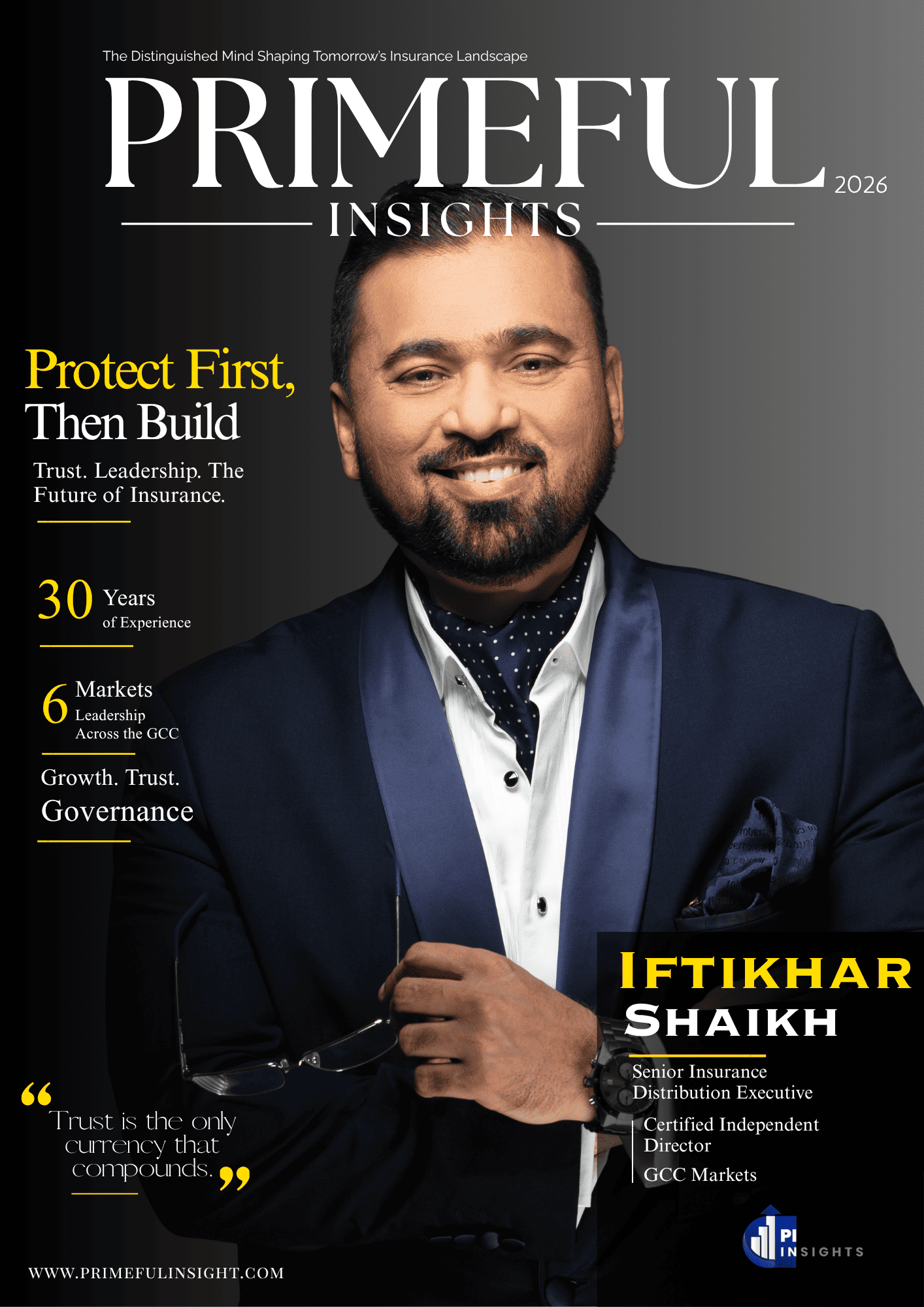
Protect First, Then Build: Iftikhar Shaikh on Trust, Leadership, and the Future of Insurance
Senior Insurance Distribution Executive | Certified Independent Director | GCC Markets
With three decades of experience across six markets, Iftikhar Shaikh has built his career around a simple principle: protect what matters before trying to grow it. From his early sales role in Mumbai to senior distribution positions across the Gulf, he has seen what helps a business succeed over time. For him, that means making sound commercial decisions, building capable teams, and ensuring customers receive what they were promised.
The Principle That Connects a Career
Ifti began his career in motor oil sales before moving into life insurance, financial services, and senior leadership across the Gulf Cooperation Council (GCC). Although the industries and responsibilities changed, one thing remained constant: the importance of delivering on a promise to a customer.
“I like to say I have spent my whole career keeping things running smoothly. First it was engines, then it was families’ finances,” he reflects. The comparison captures his practical approach. A sale may complete a transaction, but the real test comes later, when a product needs to deliver on its promise. His experience across agency, bancassurance, and broker distribution has taken him through markets with different regulations, customer expectations, and commercial demands. Each has required him to adapt while maintaining consistent standards. After nearly three decades in financial services and distribution, Ifti is now open to senior leadership roles and independent board mandates. He hopes to bring his operational experience to questions of governance and oversight while helping professionals entering the industry develop their skills.
From Motor Oil to Financial Protection
Ifti entered the workforce in 1996 as a Sales Supervisor in the Car Care division of Pennzoil Quaker State in Mumbai. The role taught him the fundamentals of selling: understanding a product, explaining its value, building relationships, and earning customer confidence.
One lesson from those early years stayed with him.
“Selling is selling, but trust is the only currency that compounds.”
That idea took on greater significance when he moved into financial services. In 2003, he joined ICICI Prudential in life insurance, followed by roles at Max Life, HDFC Bank in bancassurance, and Nippon Life India in asset management. Each position gave him a broader understanding of how financial products reach customers and how business goals connect with their needs. When Ifti moved to the Gulf in 2011 to join a leading multinational life insurer, he brought experience in sales, insurance, banking-led distribution, and investments. Life insurance, however, introduced him to a different kind of responsibility.
“No ten-year-old dreams of discussing term cover at the dinner table,” he says. “I certainly didn’t. But once I saw what a policy does on the worst day of a family’s life, I never wanted to sell anything else.” As he learned more about the role insurance plays during illness, loss, and financial uncertainty, he began to see the work differently. A policy was not simply a product sold against a target. Its value depended on whether it could help a family when circumstances became difficult. That understanding influenced how he approached business growth. Sales mattered, but so did choosing suitable policies and helping customers maintain their cover. His experience in India and the Gulf showed him that commercial performance and customer interests could support one another when a business was managed well.
Building at Scale Without Losing Sight of the Customer
Ifti’s responsibilities grew considerably during his years in the Gulf. He led more than 350 financial advisors across the UAE, Kuwait, Qatar, Bahrain, and Oman, overseeing a portfolio exceeding USD 120 million in gross written premium. He also secured regulatory approval to enter a new Gulf market before taking charge of the operation as Country Manager. Managing a regional business meant understanding the differences between markets. Regulations, customer expectations, and distribution practices varied from one country to another, so a successful approach in one market could not simply be copied elsewhere.
His regional agency was named the network’s Best Agency in EMEA for three consecutive years, from 2022 to 2024. In 2024, it also received the network’s highest internal audit rating. The business had recorded five consecutive years of double-digit growth. For Ifti, these results are meaningful when considered together. Sales growth shows commercial progress, while a strong audit rating provides evidence that the processes supporting that growth are working.
“One award can be a good year. Three in a row, with a clean audit, is a culture.”
He is more interested in the habits behind these achievements than in awards alone. Results that depend on constant pressure or a few exceptional individuals can be difficult to maintain. Capable teams, clear standards, and consistent processes give a business a stronger foundation for long-term performance.
His participation in global leadership programmes in Romania and Greece strengthened another conviction: sound judgment matters more than memorising a formula.
“Good judgment travels better than good scripts,” he observes. This becomes especially important when managing teams across borders. Shared values can guide a regional business, but leaders must understand local conditions and know which practices can be adapted without compromising essential standards.
Why Protection Must Come Before Growth
Ifti’s professional philosophy comes down to four words: “Protect first, then build.” He applies this principle to financial planning, where the desire to accumulate wealth can overshadow the need to safeguard income and assets. Someone may spend years saving, investing, and buying property without fully considering how illness, death, or another unexpected event could affect the family’s finances.
“Wealth without protection is a house without a foundation,” he says.
Insurance cannot prevent hardship, but appropriate cover can reduce its financial impact. Ifti sees it as a basic part of financial planning rather than something to consider only after other financial goals have been achieved. The same thinking shapes his approach to distribution. A policy is not a success simply because a customer has signed up. It must remain suitable for the customer’s circumstances and be in force when a claim arises.
“When a policy lapses, nobody wins. The customer simply loses.” When a policy lapses, customers may lose the benefits they expected in return for their premiums. Replacing the cover can also mean higher costs, new medical assessments, or fewer available options, depending on their circumstances.
For this reason, Ifti believes distribution teams should be measured on retention and persistency alongside new business. The same principle applies to group medical insurance. Winning an employer’s scheme is one achievement; maintaining it with satisfied members and a healthy loss ratio offers a clearer measure of how well it is working.
“Short-term growth rents results one quarter at a time. Long-term value compounds them.” Sales targets can sometimes push suitability and service into the background. Ifti encourages teams to look beyond the initial transaction. Do customers understand their benefits? Is the cover appropriate? Is there a reasonable chance they will maintain it?
These questions matter long after the paperwork is complete. Over time, the quality of a distribution business becomes clear through the experience customers have with the products they purchased.
Leadership When Circumstances Change
Running a regional business means managing several demands at once. Some of Ifti’s most challenging periods came when expansion coincided with disruption, leaving little room to focus on one issue at a time. Entering a new market requires regulatory approval, local relationships, and careful operational planning while the existing business continues to run. Progress depends on preparation and credibility, not enthusiasm alone.
“There is no express lane at a regulator. Believe me, I looked.”
The lesson is straightforward: some processes cannot be hurried. Leaders must keep work moving without assuming every obstacle can be overcome on their preferred timetable. The pandemic brought a different set of challenges. Ifti’s distribution model depended heavily on face-to-face meetings between advisors and customers. When those meetings were no longer possible, remote advice, virtual onboarding, and new methods of coaching became necessary. Teams had to adjust their working methods while maintaining customer relationships.
Technology made the transition possible, but relationships built before the disruption also played an important role. Advisors who felt supported by their managers had a stronger basis for staying engaged, while established customer relationships helped sustain conversations in unfamiliar circumstances.
“Resilience isn’t pushing harder. It’s staying steady when everything else moves.” For Ifti, steadiness means communicating honestly, making decisions without adding to uncertainty, and giving teams a clear sense of what needs to happen next. Leaders cannot always provide immediate answers, but they can explain what is known, acknowledge what remains unclear, and keep people focused on the work ahead.
Retaining talent presents a longer-term challenge. Advisor attrition remains a concern across the industry, and recruitment alone cannot solve it. Ifti has emphasized structured training, clear career paths, and managers who coach their teams rather than concentrating solely on targets. Advisors need to understand what is expected of them and see a credible path for their own development. They also need to know that responsible conduct matters alongside commercial results. For Ifti, these are practical requirements for building a team that performs consistently.
Governance as a Foundation for Sustainable Growth
Ifti’s operational experience has also shaped his approach to corporate governance. Through his work on a steering committee aligning regional operations with new UAE Central Bank governance regulations, he saw how regulatory requirements affect daily business decisions and a company’s readiness to grow. He does not view governance as an administrative exercise separate from commercial operations. When integrated into decision-making, it clarifies accountability, establishes consistent standards, and helps a business identify problems before they become harder to address.
“Treat governance as a growth lever, not a tax.”
In financial services, poor decisions can have consequences beyond an immediate financial loss. Weak controls, unclear responsibilities, or unsuitable sales practices can harm customers and damage a company’s reputation, making future growth harder to sustain. Ifti has seen that commercial ambition and oversight can work together. The sustained growth and high internal audit rating achieved by the business he led offered a practical example of how both can be maintained.
He is also wary of systems that depend too heavily on one capable executive. Good decisions should not require the constant presence of a particular individual. An organization needs clear processes and responsibilities that allow people to act appropriately at every level.
“Build trust in the architecture, not just the leader.”
His qualifications in independent directorship, corporate governance, and environmental, social, and governance (ESG) matters build on that experience. They give him additional frameworks for examining risk, accountability, and long-term organizational performance from a board-level perspective.
Preparing the Next Generation of Leaders
For Ifti, professional development does not end with a degree, a promotion, or years of experience. The more responsibility a person takes on, the more important it becomes to keep learning.
“Be the least experienced person in the room. It means you’re in the right room.” His education has continued alongside his career. He has studied project management, reinsurance administration, strategic finance through IIM, and Islamic banking. More recently, he added qualifications in corporate governance, independent directorship, and ESG.
He sees these studies as ways to broaden his understanding rather than simply add credentials to his résumé. Each offers a different perspective on decision-making, risk, and unfamiliar challenges.
“Your degree gets you in the door; what you keep learning decides how far you go.”
His advice to younger professionals is not to follow a prescribed route. He encourages them to remain curious beyond the requirements of their current role. Industries change, customer expectations shift, and experience becomes less useful when it replaces a willingness to learn. Ifti also values integrity, openness to feedback, and the ability to help others develop confidence. He believes criticism is often wasted when people treat it as a personal slight rather than an opportunity to improve.
“Every honest piece of feedback is months of trial and error handed to you in one conversation.”
When mentoring professionals, he encourages them to compare their progress with their own earlier performance instead of constantly measuring themselves against colleagues. Looking back over six months can reveal improvements that are easy to miss when attention is fixed on someone else’s career. This thinking informs his forthcoming book, The Book of Building Confidence: A Leadership Philosophy for Building Trust and Inspiring Confidence.
“Confidence is not something leaders demand. It is something they build.”
In practice, Ifti believes confidence grows when people know what is expected of them, receive fair treatment, have support when difficulties arise, and are trusted with meaningful responsibility. A job title cannot provide those things on its own.
The Future of Insurance: Educating Rather Than Simply Selling
Ifti expects the GCC insurance market to be shaped increasingly by changing customer expectations, new technology, distribution models, and regulatory standards. One of the industry’s central tasks, in his view, is helping people understand what they are buying and why it matters.
“The winners won’t out-sell the next generation. They’ll out-educate them.”
Group medical insurance and employee benefits are important areas to watch. As healthcare costs rise, employers and insurers face greater pressure to design schemes that remain affordable and effective. Third-party administrators and managed-care partners can contribute through provider-network management, claims analysis, and measures to control costs. The distribution landscape offers opportunities, too. Bancassurance gives insurers access to customers through established banking relationships, while brokers and agency networks serve different segments and needs. The challenge is to make each channel work well without allowing sales targets to override suitability or service.
Younger customers bring different expectations to these relationships. They can access information quickly and are less likely to respond to a conventional sales pitch that does not address their circumstances. That does not necessarily mean they are uninterested in insurance. They may simply expect clearer information and a more relevant conversation. Ifti also sees scope for Takaful, or Sharia-compliant protection, to expand in the GCC. His diploma in Islamic banking has helped him understand this area, particularly in markets where customer preferences create room for further development.
Artificial intelligence is likely to affect underwriting, servicing, and claims. Ifti takes a practical view of its role: technology should help professionals serve customers better by making information easier to access, reducing avoidable delays, and giving advisors more time to understand individual needs. Automating a poor process will not improve the underlying experience, but well-designed tools can help advisors prepare more thoroughly and respond more effectively. The protection gap across the Gulf remains a significant challenge. Closing it will take more than launching new products or digital platforms. People need to understand the cover available to them, and insurers must be able to deliver what their policies promise.
A New Chapter Built on Experience
After 30 years spent building distribution businesses for major insurers, Ifti is approaching his next career move deliberately. He describes the period as a strategy review rather than a career break.
He is open to leading a regional or country business, taking on a commercial or distribution role, or working with an insurer, intermediary, health insurer, or third-party administrator seeking profitable growth across the GCC. Independent director mandates are another possibility, allowing him to bring an operator’s perspective on distribution, governance, and ESG to boardroom discussions. Mentoring is also a priority. Ifti believes the industry’s ability to close the protection gap depends partly on having advisors who understand the products they recommend and put customer interests ahead of short-term targets.
His background includes multi-country market entry, substantial commercial responsibilities, and experience across agency, broker, and bancassurance channels. His governance qualifications give him a broader perspective on how these businesses are managed and overseen.
Yet his underlying professional objective remains much as it was when he started in 1996.
“My long-term objective has not changed since 1996. I am still selling the same thing I sold back then: confidence that what you have bought will work when you need it. The product has just become a great deal more important.” The statement brings his career back to its starting point. The products and markets have changed, but the question at the centre of his work remains the same: will the customer be able to rely on what was promised?
The Measure of Trust
In an industry often judged by targets, portfolios, and growth figures, Ifti’s career points to a less immediate measure of business quality. What happens after the sale can reveal more than the sale itself. A policy that remains in force, a customer who understands the cover purchased, an advisor who grows in competence, and a team that maintains its standards during a crisis all indicate that a business is meeting its responsibilities. These outcomes depend on everyday decisions and the systems that support them, not on reputation alone.
As Ifti considers his next chapter, he hopes to bring that experience to new leadership and boardroom roles while helping other professionals prepare for the demands of the industry. Across three decades and six markets, he has seen how technology can improve processes and governance can strengthen oversight. Neither, however, can make up for a product that fails when a customer needs it.
For Ifti, that remains the responsibility at the heart of insurance: protect first, then build.