
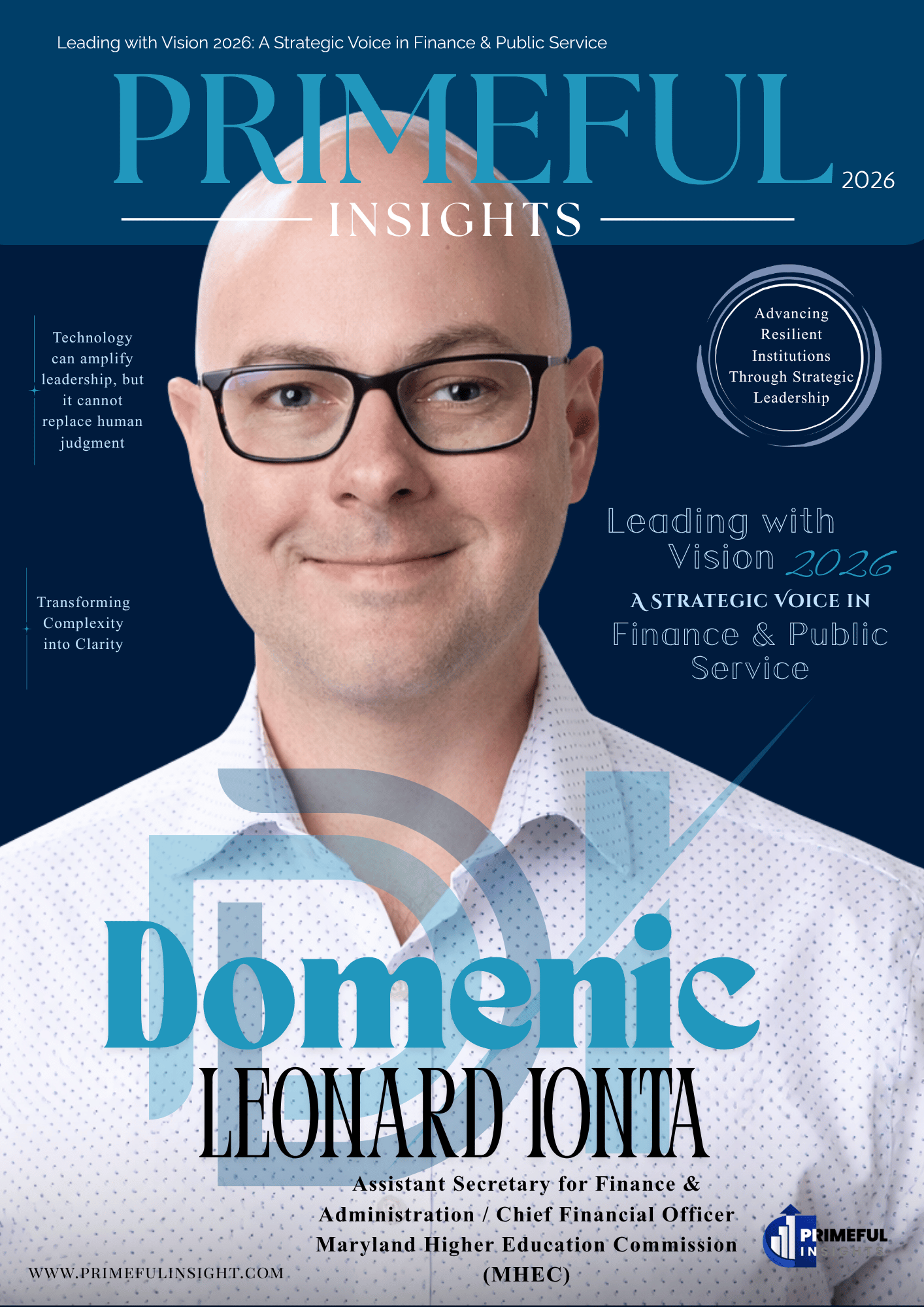
Leading with Vision: Domenic Leonard Ionta on Clarity, Resilience and the Future of Public Service
Leadership is often tested not when the path is clear, but when it is not.
In public institutions, where decisions can affect communities, resources, employees and public confidence, ambiguity is rarely an academic problem. It is part of the job. Leaders must make choices with incomplete information, balance competing priorities, manage risk and keep an organization moving toward its larger purpose. For Domenic Leonard Ionta, that reality has shaped a career spanning public service, management consulting, higher education, finance, governance, homeland security, international affairs and strategic advisory work.
Today, as Assistant Secretary for Finance & Administration and Chief Financial Officer at the Maryland Higher Education Commission, Ionta occupies a role where financial stewardship and institutional leadership meet. His responsibility extends beyond budgets and administration. It involves strengthening the systems, governance and operational foundations that allow a public institution to fulfill its mission effectively. Across more than two decades of professional experience, one principle has become increasingly central to his approach:
“Clarity is mercy, and brevity is competence.”
It is a concise philosophy, but one that says much about how Ionta views leadership. People cannot perform at their best when expectations are unclear, priorities compete without explanation or decision-makers are buried beneath information that does not lead to action. For Ionta, effective leadership begins with making the important things understandable.
A Career Built at the Intersection of Mission and Complexity
Ionta’s professional journey has never been confined to a single discipline. His experience has included federal government service involving homeland security, international affairs, immigration, emergency management and legislative affairs. Those environments exposed him to institutions operating under significant public responsibility and taught him that decisions made inside government can carry consequences far beyond the meeting room in which they are made.
His time at Deloitte brought a different perspective. Management consulting provided a disciplined focus on organizations, transformation, strategy, performance and execution. The contrast between public institutions and consulting environments proved valuable. One emphasized stewardship and public trust; the other brought a strong focus on organizational performance and translating ambitious goals into executable plans. Over time, Ionta developed an approach that connects the two. A strategy has value only when it can be executed. A budget has meaning only when it supports a mission. Information becomes useful when it helps someone make a better decision.
His academic journey reinforced the same mindset. An MBA from Carnegie Mellon University, followed by experience teaching as an adjunct professor, strengthened his belief in intellectual curiosity and continuous learning. For Ionta, expertise should never become an excuse to stop asking questions. The strongest leaders remain willing to challenge their assumptions and recognize that even experience cannot eliminate uncertainty.
The Defining Question: Does the System Still Work?
One of the most revealing aspects of Ionta’s philosophy is his approach to innovation. In a world where innovation is often associated with new technology, artificial intelligence or automation, he takes a more fundamental view. Sometimes innovation begins with a question: Why do we do it this way?
What problem was the process originally designed to solve? Does it still solve that problem? Where are the greatest risks? What information would enable leadership to make a better decision? These questions may sound simple, but they can expose some of the most persistent weaknesses inside institutions.
Organizations accumulate processes over time. Some remain necessary. Others continue largely because nobody has stopped to question them. Ionta believes effective leaders need the courage to examine those assumptions without automatically replacing everything that came before.
That distinction is particularly important when discussing technology. Artificial intelligence, data analytics, automation and increasingly sophisticated decision-support systems have enormous potential. But Ionta does not see technology as a substitute for leadership. He sees it as an amplifier. Technology can help institutions process information faster and identify patterns that might otherwise remain hidden. It can improve productivity and support evidence-based decision-making. But the responsibility for determining what matters, what is ethical, what is appropriate and what should ultimately be done remains human. The future, in his view, belongs to institutions that can combine technological capability with sound governance, financial discipline, institutional knowledge and human judgment.
Stewardship Before Status
At the center of Ionta’s definition of success are three concepts: mission, stewardship and trust.
The order matters. An organization can achieve short-term targets and still lose its strategic direction. A noble mission, meanwhile, cannot compensate indefinitely for weak execution or poor resource management. In public service, this responsibility becomes even more significant because the resources being managed ultimately belong to the public. Ionta therefore views financial management as far more than an accounting exercise.
A budget communicates priorities. Where an organization chooses to invest, where it reduces spending, what risks it accepts and what capabilities it protects all reveal what it genuinely values. That makes financial management a strategic responsibility. His approach is to translate broad objectives into measurable priorities and establish the structures necessary to monitor whether those priorities are being achieved. Executive dashboards, risk registers, scenario analysis, milestone calendars and concise briefing materials can help leadership separate information that is merely interesting from information that actually requires attention. This reflects another important element of his philosophy: accountability should be visible. People need to know who owns a decision, what the expected outcome is, when progress should be measured and what happens if circumstances change.
The goal is not bureaucracy for its own sake. It is clarity that allows an organization to act.
Leadership When the Answer Is Not Obvious
Some of the most consequential lessons in Ionta’s career have come from situations where there was no perfect answer. Incomplete information, competing priorities, limited resources, organizational change and uncertainty are common features of complex institutions. Waiting for complete certainty is therefore rarely a practical approach. The challenge is knowing which uncertainties matter.
Ionta approaches ambiguity by separating consequential uncertainty from background noise, identifying the risks that could materially change an outcome and making the best defensible decision available. That requires judgment. It also requires the ability to look beneath symptoms. A budget problem may actually be a governance problem. A technology failure may expose a process weakness. An audit finding may reveal something deeper than a compliance deficiency. It may reveal a cultural problem. For Ionta, effective problem-solving therefore begins with understanding root causes.
Establish the facts. Identify accountable owners. Define achievable milestones. Communicate expectations. Then create mechanisms that allow leadership to determine whether corrective action is actually working. This approach is closely connected to his understanding of resilience. Resilience is not about creating organizations in which nothing ever goes wrong. That is impossible. It is about creating institutions capable of absorbing disruption, learning from it, adapting and continuing to function.
The Institutional Resilience Imperative
Ionta believes organizations will face an increasingly complicated operating environment, with pressures that extend well beyond any single technology or policy challenge. Artificial intelligence will continue to reshape government, higher education, consulting and knowledge-based work, while fiscal pressures will require institutions to accomplish more with constrained resources. At the same time, organizations will need to respond to cybersecurity threats, geopolitical volatility, demographic change, workforce transitions and changing expectations around institutional performance.
These pressures make resilience less about predicting every disruption and more about building the capacity to respond when circumstances change.
That means maintaining visibility into costs, performance and risk, while ensuring that critical systems can adapt under pressure. It also means recognizing that institutional trust can be difficult to rebuild once it has been weakened. The strongest organizations, in Ionta’s view, will not necessarily be those that anticipate every disruption correctly. They will be the ones with the governance, discipline and adaptability to respond when their assumptions prove wrong.
The Six Qualities That Matter
For the next generation of leaders, Ionta identifies six qualities as particularly important: integrity, judgment, curiosity, resilience, empathy and decisiveness.
Integrity comes first because trust cannot be sustained without it. Judgment becomes increasingly valuable as technology gives professionals greater access to information and analytical capability. Knowing more is useful, but knowing what matters is even more important.
Curiosity prevents expertise from becoming complacency. Resilience allows professionals to continue functioning through uncertainty and setbacks. Empathy ensures that leadership does not lose sight of the people behind the processes and performance measures. Decisiveness matters because leadership ultimately requires choices. Analysis should inform decisions, not become a reason to postpone them indefinitely. Perhaps most importantly, Ionta encourages emerging leaders to become comfortable saying three things: “I don’t know.” “I was wrong.” “Here is what we are going to do next.”
Each statement requires confidence. The first demonstrates intellectual honesty. The second demonstrates humility. The third demonstrates leadership. Together, they reflect an approach that values learning without sacrificing action.
Building a Career Around Contribution
Ionta’s priorities for the future extend beyond professional advancement. He intends to continue working at the intersection of leadership, governance, institutional resilience, public service and strategic advisory work, while expanding his contribution through writing, teaching, mentorship and thought leadership. At the heart of those priorities is a belief in the importance of strong institutions. Whether the setting is government, higher education, business or civil society, functioning institutions provide the foundation upon which broader social and economic outcomes depend. Ionta wants his work to help leaders navigate complexity, manage risk, steward resources responsibly and approach consequential decisions with greater clarity.
Writing has become another part of that contribution.
Through his work as an author, he has explored resilience, survival, service, leadership and the human experiences that sit behind professional identities. It offers him an opportunity to examine leadership from a perspective that cannot always be captured by a résumé or organizational chart. He also sees strategic advisory work as an important part of the next stage of his career, particularly in areas where governance, geopolitical risk, organizational resilience, technology and public policy intersect.
The common thread remains contribution.
Leaving Institutions Stronger
After years spent moving through public service, consulting, academia, finance and strategic leadership, Domenic Leonard Ionta does not measure the next chapter of his career primarily through titles. His measure is impact: institutions strengthened, people developed, difficult problems made more manageable, better decisions made possible and ideas that continue to create value after the original conversation has ended.
That perspective reflects a deeper understanding of what leadership means. A leader does not control every outcome. No institution operates with perfect information, unlimited resources or predictable circumstances. But leaders can create clarity. They can establish accountability. They can protect trust. They can build systems capable of adapting. And they can make sure that the people around them understand not only what they are being asked to do, but why it matters. For Ionta, a career is cumulative. Every assignment, success, failure, mentor, colleague and unexpected challenge contributes something to the person who enters the next room.
The next chapter, then, is never entirely separate from the ones before it. Federal service informs financial stewardship. Consulting informs execution. Academia reinforces curiosity. Leadership experiences deepen judgment. Writing creates space for reflection. Strategic advisory work brings those lessons together. The objective remains consistent: to contribute meaningfully wherever the work leads.When institutions are being asked to move faster while facing greater scrutiny, complexity and uncertainty, that kind of leadership matters. Not because it promises simple answers, but because it recognizes that important decisions rarely come with them.
The task is to ask better questions, see the system clearly, understand what is at stake and act with discipline when certainty is unavailable. That is the kind of leadership Domenic Leonard Ionta continues to pursue. And perhaps his philosophy can be distilled to the principle at the center of his approach:
Make the complex clear. Steward what has been entrusted to you. Build resilience before it is needed. And leave the institution stronger than you found it.