
Beyond the Possible: Jens Sørensen and the Power of the Wide View
Some leaders build their careers by becoming specialists. Others become valuable because they learn to see what specialists sometimes cannot: the wider picture.
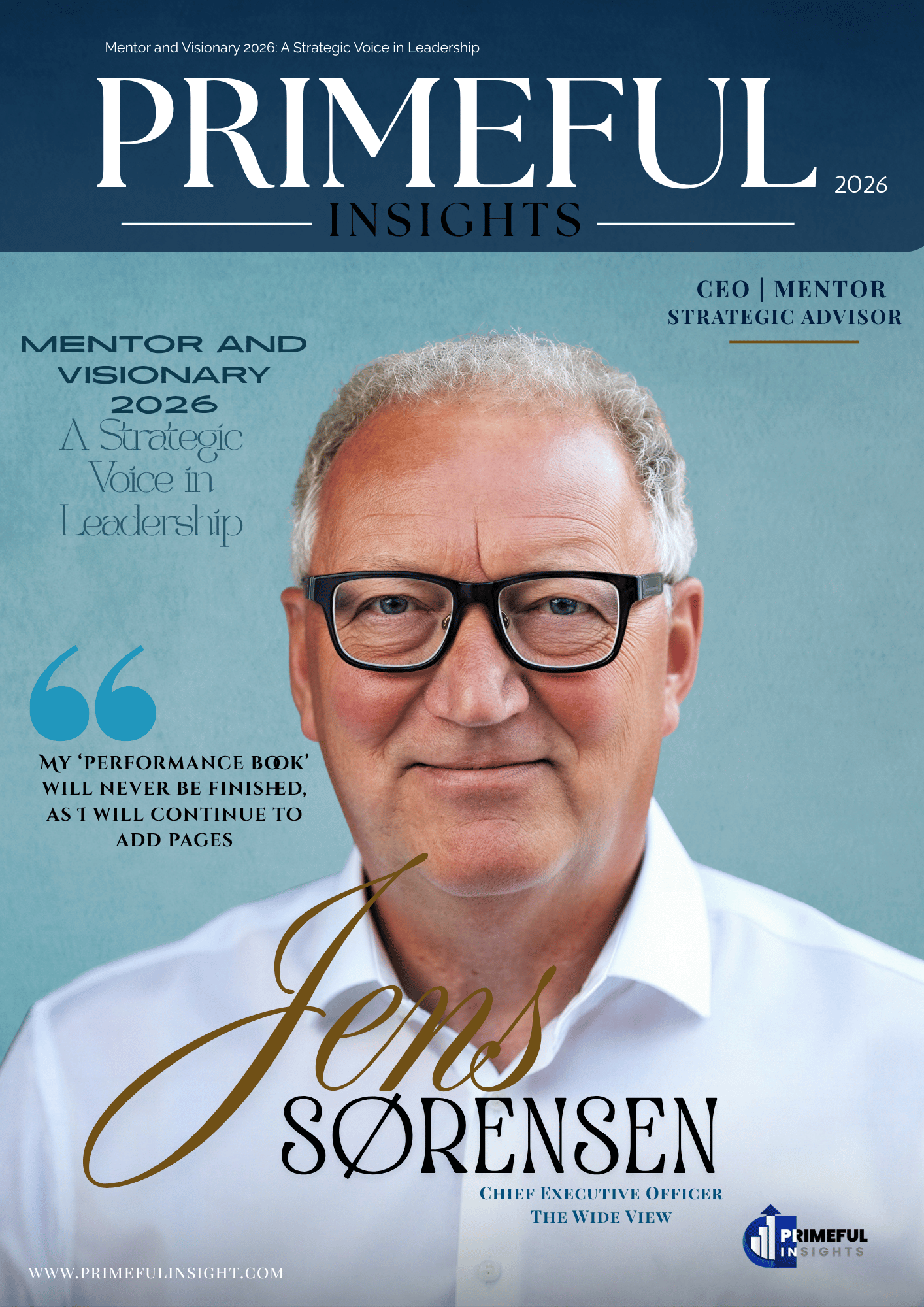
Jens Sørensen belongs firmly to the second category. Born in Middelfart, Denmark, in 1959, Sørensen has spent decades moving between finance, operations, automotive, executive leadership, strategy, mergers and acquisitions, and board-level advisory work. The breadth of that experience matters, but what defines him more clearly is his ability to connect the different pieces. Today, as the founder of The Wide View, Sørensen works as a strategic adviser across industries, with deep expertise in automotive. He also serves on professional and advisory boards, mentors leaders and speaks about business and leadership. His philosophy is captured in the phrase that has come to represent his work: “The Wide View. Beyond the Possible.”
For Sørensen, seeing beyond the possible does not mean pursuing ideas simply because they sound ambitious. It means understanding what makes a company work from the inside out.
“To become successful you must firstly care about the soul in a company. If not; the inner mechanism will die,” he says. That belief has been at the heart of a career built around one central question: how can a company perform better without losing the people and purpose that make performance possible?
A Career Shaped by Operational Reality
Sørensen’s professional journey began in finance and administration. From 1977 to 1998, he worked with Lydex, Walker and Tenneco, eventually taking on senior executive responsibility across Scandinavia. Those early years gave him something that would later become central to his thinking: a practical understanding of how business actually operates. Finance can reveal whether a business is performing. Operations can reveal why. People determine whether that performance can be sustained. That combination prepared Sørensen for his next major chapter. In 1999, he became CEO of ad-DATI, then Denmark’s largest automotive wholesale cooperation.
It was an important transition. He was no longer responsible for understanding only parts of a business; he was responsible for bringing the organisation together around a common direction. Soon after, Sørensen was headhunted by executive search firm Egon Zehnder, opening the door to another defining stage of his career. From 2001 to 2014, he moved into FTZ, Denmark’s largest single-standing automotive wholesale company, first as Chairman and later as CEO. During this period, he worked on the formation of the Nordic Forum and developed a strategic outline that would take the organisation toward approximately €640 million in turnover. The financial scale was significant, but perhaps more revealing was the importance Sørensen placed on culture.
When Strategy Begins With People
Between 2003 and 2006, Sørensen also worked in Germany with Hella, headquartered in Lippstadt, helping form what became known as the “One House Philosophy” within Hella and its aftermarket operations. Hella was also a majority shareholder in FTZ at the time.
The philosophy was deliberately human. Sørensen focused on bringing different functions and operations together and creating a shared sense of belonging, rather than allowing them to behave as separate entities. He describes the effect as a “cultural explosion” that brought people together, generated greater happiness and helped draw an additional 10 percent from each individual contributor. For Sørensen, this was not a soft alternative to performance. It was a foundation for it. His thinking has always been that strategy cannot exist independently of the people expected to execute it. A sophisticated plan means very little if the organisation lacks the structure, culture and human alignment required to carry it forward.
“I have always had structure UP before strategy,” he explains. “In my opinion you can not make/form a strategy before you have the guiding and human formation (to carry things through) in place.”
It is a perspective that distinguishes his approach from leadership models that begin with strategy and treat people as an implementation layer. Sørensen starts somewhere else: build the structure, develop the people and establish the ability to execute. Then decide where the organisation should go.
The Wide View Takes Shape
In 2015, Sørensen entered a new chapter by forming The Wide View, establishing himself as a strategic adviser working across industries. The shift represented more than a change in professional title. After decades of operating inside businesses, Sørensen could step back and observe them from a broader vantage point. His work today includes strategic advisory, board responsibilities, advisory board roles, mentorship and M&A expertise. Rather than being tied to one sector, he brings an experienced generalist perspective to complex business situations while maintaining automotive as his area of particular expertise. That breadth is intentional. Sørensen believes that remaining curious about different industries makes it possible to recognise patterns that may not be obvious when looking at a single sector in isolation.
“I believe in attitude and gratitude,” he says.
The statement is simple, but it reflects an important part of his philosophy. Technical knowledge alone is not enough. The attitude with which leaders approach problems, people and change matters just as much. For Sørensen, everything also has to connect to purpose.
“Everything has to be purpose driven.”
That purpose-driven approach sits alongside an intense personal commitment to development. He describes his “performance book” as something that will never be finished because he intends to keep adding pages. It is perhaps the clearest illustration of how he sees leadership: not as a destination, but as an ongoing process of refinement.
Building His Own Tools
One of the most distinctive elements of Sørensen’s approach is his determination to develop original management tools rather than simply repeat established leadership frameworks. He is comfortable learning from conventional management thinking, but he does not believe conventional thinking alone produces extraordinary results.
“It is OK to manage ‘by the book’,” he says. “However, when this is done via the many standard leadership books and educations that rotates and rotates, year after year, it will never lead into something out of the extraordinary.”
Instead, Sørensen continually challenges himself to develop his own additions and methods. Among his self-developed management tools are the five “spikes” of his management star:
JS: One House Philosophy focuses on bringing people together around a shared organisational identity.
JS: A-B-C Roll-out & Costing provides a structured approach to implementation and cost considerations.
JS: Chamber of Control Kit reflects his emphasis on maintaining visibility and control across an organisation.
JS: Rating System brings another layer of structured evaluation into management.
JS: Savings by Coming First reflects his belief in the value of anticipation rather than simply reacting after problems emerge.
Above these tools sits what Sørensen calls his “Operational Tower”, an overarching perspective built around three priorities: seeking constant improvements, following financial movements on an international scale, and digging deeply into transformation and innovation to identify new ways and new solutions. Together, these ideas reveal an important characteristic of his leadership style. Creativity, for Sørensen, is not separate from structure. It works through structure.
Performance Without Losing the Human Side
For someone who has spent much of his career focused on performance, Sørensen’s definition of success is surprisingly personal. Asked what he is most proud of, he does not point first to turnover, transactions or titles.
“That I never missed a budget as CEO and that I stood up for my people no matter what happened,” he says. “I never left them alone.”
That statement says much about the kind of leader he has tried to become. Financial discipline matters. Results matter. Accountability matters. But performance, in his view, cannot come at the expense of the people responsible for creating it. This is also why Sørensen describes himself as a people person.
“I pick my people and network very carefully.”
His approach to relationships is deliberate rather than purely transactional. The people surrounding a leader influence the quality of ideas, decisions and execution. Choosing them carefully therefore becomes part of the strategy itself. It is also where his philosophy about the “soul” of a company becomes particularly relevant. An organisation can have strong systems, sound finances and a compelling strategy, but if the people inside it become disconnected, the internal mechanism eventually weakens. For Sørensen, the human dimension is not an accessory to business performance. It is part of the mechanism that produces it.
A Discipline of Constant Improvement
Today, Sørensen divides his working time according to a structure that reflects his own philosophy of balance and continuous development. Approximately 50 percent of his time goes toward support and analysis across functional elements. Another 25 percent is dedicated to guidance and idea generation. He allocates 15 percent to his own development and reserves 10 percent for reflection. The allocation is revealing. Even at a stage of his career when he could reasonably rely on experience, Sørensen deliberately reserves time to improve himself.
“I’m actually never 100% satisfied. There is always room for improvement(s).”
That dissatisfaction is not presented as negativity. It is a form of professional discipline. He believes excellence requires an ongoing willingness to question what has already been achieved. What worked yesterday may not be enough tomorrow. A successful system can always be improved. A good strategy can become stronger. A leader can continue learning.
His philosophy is therefore less about maintaining a fixed standard than continually raising it.
Creativity Beyond the Boardroom
Sørensen’s creative interests extend well beyond business. He has released ten books and recorded five music albums, adding another dimension to a career otherwise strongly associated with strategy and corporate leadership. These pursuits reinforce the breadth that defines The Wide View. Creativity does not have to exist separately from analytical thinking. In many ways, it can strengthen it. Writing requires reflection. Music requires rhythm, discipline and interpretation. Strategy requires pattern recognition, structure and imagination.
All demand a willingness to explore. For Sørensen, that exploration is part of remaining relevant. His professional identity is not limited to what he has already mastered. It is shaped by what he is still willing to discover.
The Next Chapter Is Still Being Written
After decades in executive leadership and strategic advisory work, Sørensen shows little interest in treating his career as a completed story. His work through The Wide View continues to focus on strategic advisory, board responsibilities, M&A and mentorship, with the same broad perspective that has characterised his career from the beginning. His philosophy remains grounded in attitude, gratitude, purpose, structure, people and constant improvement.
“If you can obtain recognition, you have reached the maximum,” he says.
For Sørensen, recognition is not simply an award or professional acknowledgment. It represents the point at which an individual or organisation has reached a level of excellence that others recognise. But even that achievement does not appear to satisfy his appetite for progress. His own performance book remains unfinished.
There are more pages to add, more ideas to test, more organisations to understand and more ways to improve. Perhaps that is the real meaning behind The Wide View. Beyond the Possible. It is not about believing that everything is possible without discipline or structure. It is about refusing to accept the boundaries of conventional thinking as the final answer.
Look wider, Understand the people, Build the structure before the strategy, Follow the numbers, but understand what lies behind them, Question established methods, Develop your own tools, Keep improving.
And above all, remember that an organisation is ultimately made up of people. After a career spanning finance, automotive, executive leadership, international strategy, M&A and advisory work, Jens Sørensen continues to approach business with the curiosity of someone who knows there is always another perspective to uncover.
His greatest strength may not be the number of industries he has crossed or the positions he has held. It is the ability to step back, connect what others see as separate, and find the larger picture. That is the Wide View. And for Sørensen, the view is still expanding.