

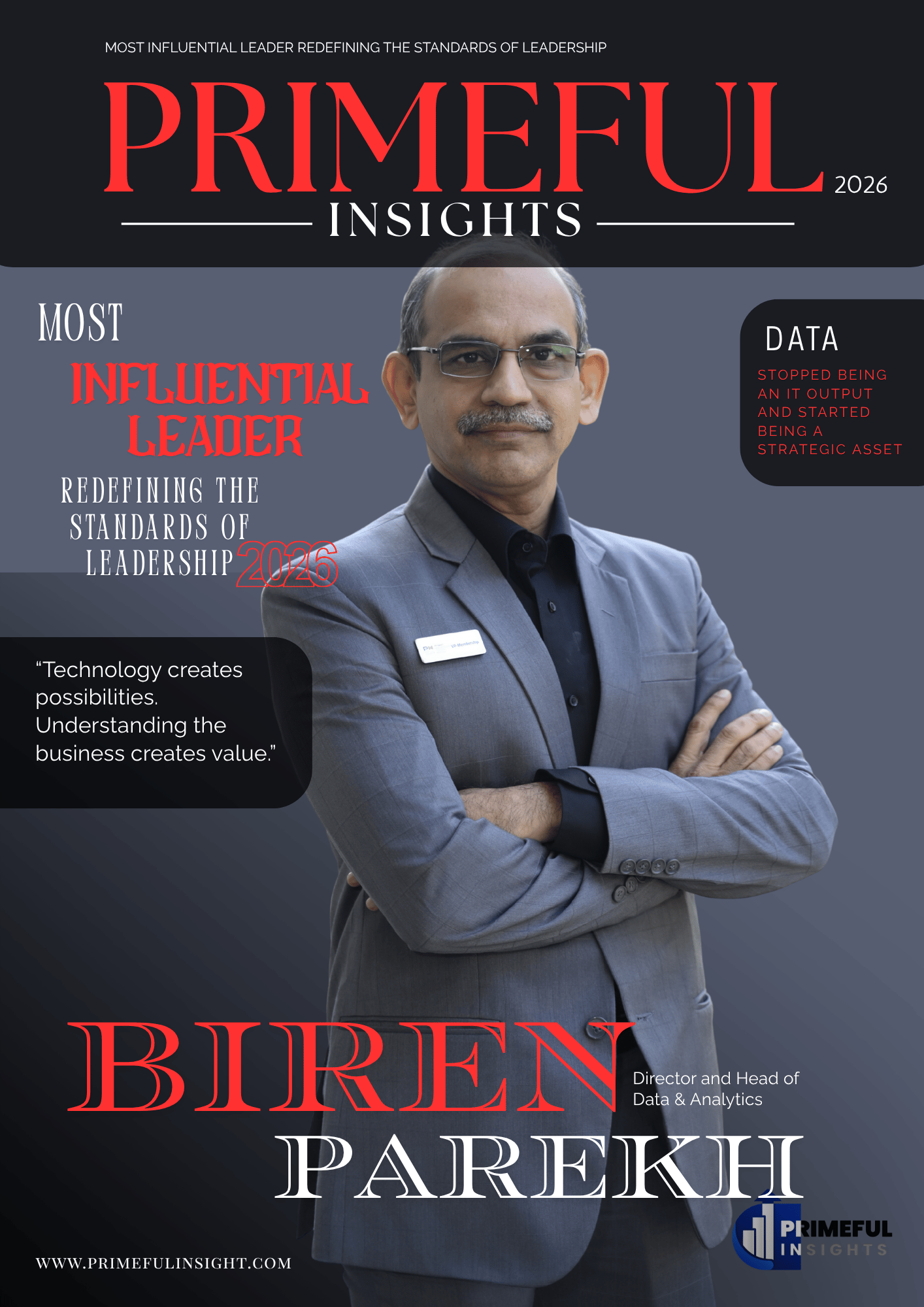
Building Organizations That Learn: How Biren Parekh Is Redefining Leadership in Data, Analytics, and Financial Technology
Technology has never been short of disruption. What is harder to find is an organization capable of absorbing that disruption, learning from it, and turning it into sustained value. For financial institutions, the challenge is particularly acute. Banking and financial services operate at the intersection of technology, regulation, customer trust, data, and increasingly complex global markets. A new platform may improve efficiency, but technology alone does not guarantee better decisions. Artificial intelligence may transform workflows, yet access to the same models does not automatically create competitive advantage. The real differentiator lies deeper: whether an organization understands its business well enough to use technology with purpose.
That idea has been central to the career of Biren, Director and Head of Data & Analytics (India) at Crisil Limited, an S&P Global company. Over nearly three decades in BFSI technology, digital transformation, data and analytics, and program delivery, Biren has worked across technology providers and enterprise organizations, led major transformation initiatives, managed substantial portfolios, mentored professionals and founders, and taught the next generation of business leaders. Yet the thread connecting those experiences is not technology itself. It is the question of how organizations can become better at learning, adapting, and creating value.
His answer begins with understanding the business behind the technology.
The Lesson That Started with a Vacation
Biren’s entry into banking technology began with a decision that, in retrospect, says much about how he would approach his profession. During his engineering years, he decided he wanted to work in banking technology. He quickly realized, however, that technical ability alone would not be enough. During a college break, he taught himself accounting, working through debits, credits, and balance sheets that were not part of his formal syllabus. That decision helped him secure his first opportunity with i-flex Solutions, which later became Oracle Financial Software Services. More importantly, it established a principle that has stayed with him ever since: technology becomes valuable only when the person developing it understands the business it is meant to serve.
The lesson became even clearer as his career expanded across different markets and organizations. International implementations in Jamaica, China, Japan, the Philippines, Zambia, Nigeria, and Mauritius exposed him to very different business environments and cultural contexts. One engagement in China proved especially instructive. Technical vocabulary alone was not enough to establish credibility. A deep understanding of the client’s business was what helped secure the go-live and subsequent Phase II contract.
“I learned that credibility in banking is earned by understanding the client’s business better than they expect you to.”
That perspective continued to shape his approach as he moved from technology delivery into enterprise leadership.
Seeing the Business from Both Sides
A significant shift came when Biren moved from the vendor side to the buyer side at Barclays. For years, he had been involved in developing and presenting proposals. At Barclays, he found himself evaluating them. The change offered a different view of how enterprise decisions are actually made. Budgets had to be defended. Vendors had to demonstrate tangible value. Technology had to answer business questions rather than simply satisfy technical requirements. Seeing those decisions from the other side of the table permanently changed his understanding of value.
He came to see that technology leadership requires more than knowing how to deliver a solution. It requires understanding how organizations evaluate risk, investment, outcomes, and long-term value. That perspective, shaped by experience on both sides of enterprise relationships, continues to influence how he approaches conversations with clients and stakeholders. Later, at Intellect Design Arena,
Biren took responsibility for a portfolio reaching up to $25 million over more than eight years. The experience added another dimension to his thinking. Delivery excellence alone does not sustain a business. Commercial judgment matters. So does margin discipline. Sometimes, leadership means knowing when to decline work that does not create sustainable value. His current role at Crisil has taken that thinking further. Building the Data and Analytics practice has moved him beyond delivering systems toward influencing how institutions think about data itself. One transformation involved helping a large private-sector bank consolidate fragmented data into a governed regulatory Lakehouse. The immediate gains included improvements in reporting speed and accuracy, but Biren considers the more significant outcome to be the shift in organizational thinking.
“Data stopped being an IT output and started being a strategic asset.”
That shift captures much of the change taking place across financial services, where the value of data increasingly depends on how well organizations govern it, understand it, and put it to work.
Innovation Is About What Remains After the Launch
For Biren, innovation has never been synonymous with novelty. He is more interested in what happens after a new system goes live, when the initial excitement fades and the technology has to withstand real-world demands.
“In BFSI technology, success is not the go-live date. It is what remains six months later.”
He evaluates success across three dimensions: the client outcome, the team outcome, and the commercial outcome. A platform must perform under real volume, regulatory scrutiny, and difficult edge cases. A project should leave its people more capable and confident than when they began. The work must also generate sustainable value for both sides, rather than simply produce a successful quarter. For Biren, these measures are interconnected. A technically successful project that leaves a client struggling to maintain it, a team exhausted, or the business unable to sustain the economics is not a complete success. That philosophy is grounded in experience. At Intellect, Biren oversaw a 1,216 person-day customization program that achieved zero-defect user acceptance testing, way back in 2015. Other demanding implementations included a Trade Finance go-live delivered in six weeks and the Westpac implementation, which later received the IBS Intelligence Global Fintech Innovation Award in 2020. Yet the awards themselves are not what define his approach. His attention remains on the systems and behaviors that make successful outcomes repeatable: clear objectives, strong governance, early identification of problems, close attention to domain knowledge, and relationships in which vendors and partners are treated as extensions of the team.
Before committing to a significant initiative, he asks a simple question:
“If this succeeds completely, what actually changes for the client?”
If that answer cannot be expressed clearly, he believes the initiative is not ready, regardless of how sophisticated the technology specification may be.
What Pressure Teaches Leaders
Not every lesson in Biren’s career came from success. A particularly demanding engagement in the Philippines during 2008 and 2009 tested his ability to lead under sustained pressure. The days were long, the client relationship was difficult, and problems seemed to multiply faster than they could be resolved.
There was no clever shortcut. What worked was showing up every day, communicating uncomfortable facts early, and rebuilding trust gradually.
“I came out of it with a different temperament.”
The experience reinforced a principle that continues to shape his leadership: transparency becomes most important when the news is difficult. When circumstances are comfortable, communication is relatively easy. Under pressure, it becomes a test of judgment and character. Another challenge came from an earlier experience in which assumptions remained unstated because everyone appeared to be aligned. They were not, and the consequences surfaced later. The lesson was lasting. Ambiguity, Biren realized, is not merely a communication problem. It is an active risk. Today, he deliberately invests more time in defining what a project will and will not do, clarifying expectations, and keeping stakeholders informed before they have to ask for updates. Across different situations, his method remains consistent: establish the non-negotiable end state, be transparent throughout the process, and keep human judgment at the centre.
“Data gives you insight but people deliver outcomes.”
The Next Competitive Advantage May Be Organizational Learning
The next decade in financial services will bring profound technological change, but Biren believes the most important question will not simply be which technologies emerge. It will be which organizations know how to integrate them effectively and turn them into capabilities that last.
He identifies four major shifts. The first is the movement of artificial intelligence from assistance toward execution. The question is becoming less about whether AI can reason and more about which decisions institutions are prepared to delegate, and what accountability structures should govern those decisions. The second is the continued rise of real-time and cross-border payments. The experience of India demonstrates what instant settlement can look like at population scale, and its broader international adoption could reshape correspondent banking economics. The third is the transformation of data governance from a compliance requirement into strategic capital. As organizations experiment with AI, they are discovering that the biggest limitation is often not the model itself but the quality, lineage, and governance of the underlying data.
The fourth is the growing importance of regulation and ethics. Explainability, model risk, and algorithmic fairness are moving toward the boardroom rather than remaining technical footnotes. Around these developments, Biren sees additional growth in hyper-personalization, embedded finance, and sustainability-linked finance. Yet for all the attention these developments receive, he returns to the same underlying issue: technology is only one part of the equation.
“The organizations that separate themselves over the next decade won’t necessarily possess better technology than everyone else. They’ll possess stronger capabilities for learning, adapting, integrating new technologies, and continuously improving how they create value.”
For Biren, that capacity to learn is what turns technological change from a disruption into an opportunity.
Preparing the Leaders Who Come Next
Biren’s commitment to education and mentorship reflects the same philosophy. He regularly works with students, young professionals, and founders, and he sees several qualities as increasingly important for those hoping to build durable careers. Domain depth remains fundamental. Technology changes quickly, but understanding how a bank earns, lends, settles, and reports does not depreciate at the same rate. Professionals who understand both the technology and the business are better positioned to make decisions that matter beyond their immediate area of responsibility.
Clear communication is equally important. The ability to articulate a position, risk, or trade-off in plain language can determine whether a professional is simply executing or being invited into strategic decisions. Commercial literacy matters too. Understanding cost, margin, and value allows technology professionals to engage with the business rather than operate at its periphery. Then there is ethical judgment. As technology becomes more powerful, leaders will increasingly face decisions where the technically possible answer is not necessarily the right one. Knowing how to weigh consequences, accountability, and trust will become as important as knowing what a system can do.
Biren also draws a lesson from an unexpected part of his life: marathon running.
“Consistency compounds in a way that intensity does not.”
For him, the same principle applies to careers and organizations. Sustained progress depends less on occasional bursts of effort than on the ability to maintain direction when the initial enthusiasm has faded. Resilience, therefore, is not the absence of failure. It is the ability to respond, adapt, and rebuild trust.
Leadership Beyond the Workplace
For Biren, leadership is not limited to his professional responsibilities. Giving back has become an important part of how he contributes to the wider professional community. For more than a decade, he has been an active PMI volunteer, taking on responsibilities at chapter, regional, and global levels. His current involvement includes serving as a PMI Global Sustainability Champion for the South Asia region, advocating sustainability and Sustainable Project Management, as well as serving as a PMI South Asia Champion, supporting and advocating project management across the region. He also chairs the PMI Mumbai Chapter Ethics Committee, reflecting his interest in ethics, professional responsibility, and the standards that shape the project management profession.
His volunteering journey has included serving on the PMI Mumbai Chapter Board as VP-Membership from 2021 to 2023, acting as Conference Director for the PMI South Asia Conference 2022 in Mumbai, and serving as Awards Committee Chair for the PMI Mumbai Chapter in 2020–21. He has also contributed to PMI South Asia’s Awards Program as a jury panel member, participated in organizing committees for PM Conclave 2020 and PM Conclave 2026, and was part of the PMI India Champion Program from 2016 to 2018. His contribution extends beyond these roles. Biren has participated in Future City competition judging panels, served on the PMI Mumbai Chapter election committee, reviewed PMIEF scholarship applications, reviewed seminar proposals for PMI World, and contributed to PMI’s remote website usability testing initiative.
But for Biren, volunteering is not simply another professional credential. It is a way of giving back to a community that has contributed to his own learning and growth. That same spirit appears in a more personal initiative. Biren runs a WhatsApp channel where he shares job openings he comes across through different WhatsApp groups. Through this effort, he has helped several professionals find opportunities and take up new jobs. It is a simple initiative, but one that reflects a larger philosophy: knowledge, opportunity, and professional experience become more meaningful when they are shared with others.
Building for Reach, Not Just Recognition
Biren’s ambitions are increasingly defined by reach and permanence rather than titles.
He wants to reach a million professionals with practical knowledge across finance, fintech, and project management. He plans to publish a second book focused on finance and artificial intelligence governance, addressing what he sees as a gap between highly academic guidance and the practical needs of professionals. He also hopes to build a centre of excellence for leadership, bringing together students, founders, and practicing leaders. His continued involvement with VentureEdu, NIT Delhi, and the PMI community reflects that broader objective.
He intends to continue supporting early-stage founders, particularly those working in areas connected to inclusion, sustainability, and financial infrastructure. His work at Crisil remains another important part of that vision, with a focus on scaling the Data and Analytics practice into a capability that materially changes how clients make decisions. The recognition he has received throughout his career, from delivery and innovation awards to professional and industry distinctions, is meaningful, but he views each as evidence of contribution rather than a destination. For Biren, leadership is not about accumulating milestones. It is about creating capabilities that continue to produce value after the immediate project, role, or achievement has passed.
The Work That Continues
Nearly three decades after teaching himself accounting during a college vacation, Biren remains guided by the same underlying curiosity: understand the problem deeply, understand the business behind it, and keep learning what needs to change. The technologies will continue to evolve. Artificial intelligence will alter the nature of work, data will become increasingly central to strategic decisions, and financial institutions will face new expectations around speed, trust, regulation, and resilience.
But Biren’s perspective remains grounded in something more durable than any individual technology. Organizations that endure will be those capable of learning faster, communicating more clearly, making better decisions, and developing people who can adapt alongside the systems they build. The challenge is not simply to adopt what is new. It is to understand what that change means for the business, the people responsible for delivering it, and the clients who ultimately depend on it. His own next chapter reflects that philosophy. It is less about reaching a particular title and more about extending the reach of what he has learned through leadership, teaching, writing, mentoring, enterprise transformation, and giving back.
The message is simple, but its implications are substantial: keep building, keep sharing, and keep learning.
In a business environment where technology can increasingly be replicated, the ability to understand, adapt, and improve may prove to be the most enduring advantage of all.