
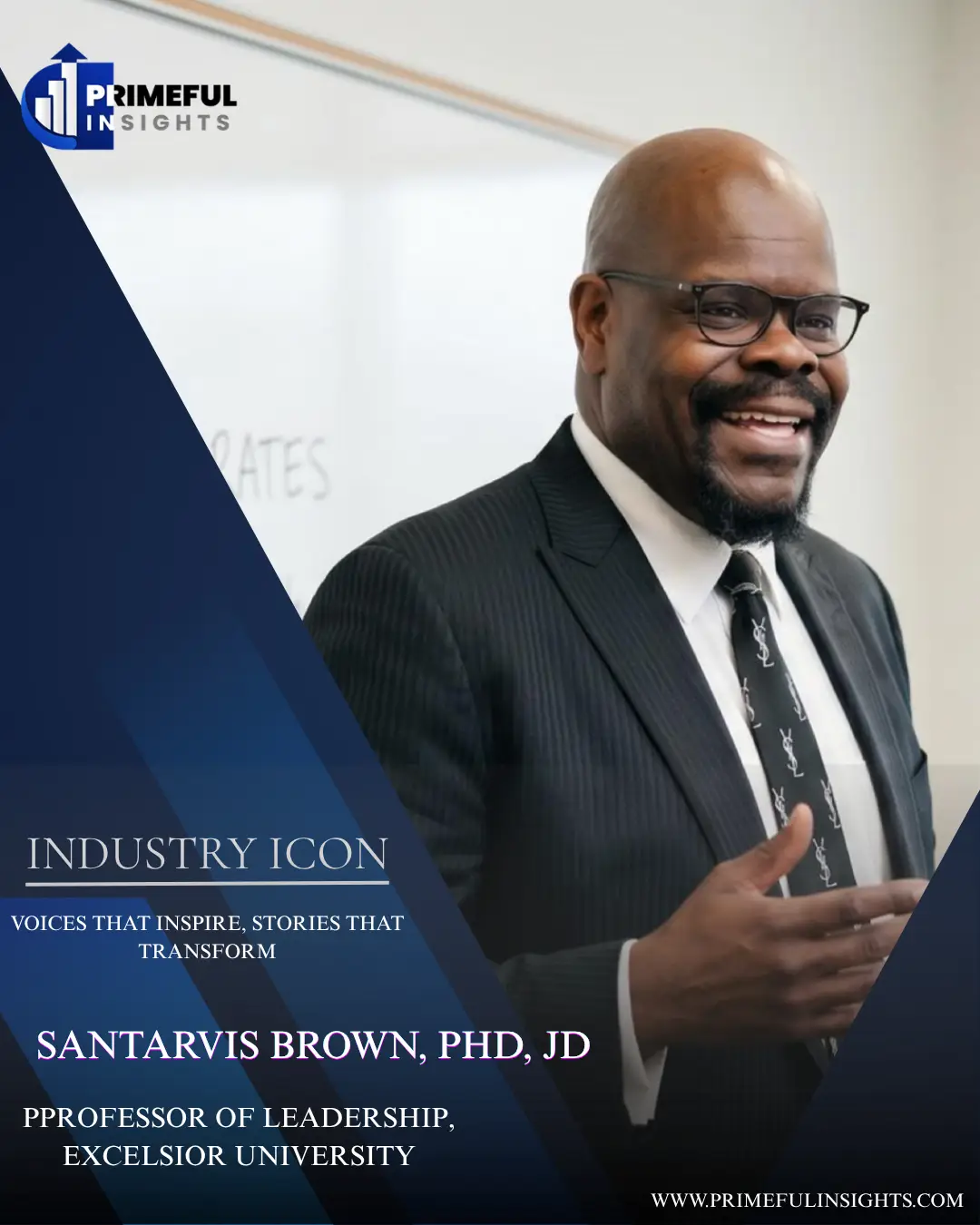
Leading with Purpose: How Dr. Santarvis Brown Is Shaping a More Human and Equitable Future Through Education and Leadership
Leadership is often associated with titles, authority, and achievement. Yet for Dr. Santarvis Brown, leadership has always meant something deeper. It is not about position—it is about service. It is about creating opportunities, building systems that empower others, and helping people recognize possibilities within themselves that they may not yet see.
Throughout a distinguished career spanning education, organizational leadership, community development, and institutional transformation, Dr. Brown has remained committed to one central belief: leadership is most meaningful when it helps others rise with dignity.
Today, as a Professor of Leadership at Excelsior University, he continues to inspire learners, professionals, and organizations through a leadership philosophy rooted in equity, accountability, compassion, and purpose. His journey reflects not only professional success but also a lifelong dedication to helping individuals and communities thrive.
A Journey Defined by Service and Transformation
Looking back, Dr. Brown sees his career as a series of opportunities to serve and create meaningful impact. His professional path has taken him through K–12 education, higher education, tribal education, nonprofit leadership, online learning, and executive academic administration. While the settings changed, the mission remained remarkably consistent.
“My journey has been shaped by the belief that education and leadership are not titles, but forms of service,” he explains.
Early in his career, he witnessed firsthand how access to education alone was often not enough. People needed encouragement, advocacy, mentorship, and supportive systems that allowed them to discover their own capabilities.
Working with underserved communities became particularly influential in shaping his perspective. Time and again, he saw what was possible when individuals were given the resources, support, and confidence to pursue their potential.
“People do not simply need access to information,” he says. “They need advocates, systems, and environments that help them recognize their own capacity.”
These experiences reinforced a lesson that continues to guide him today: leadership is not about elevating oneself—it is about creating pathways for others to grow, succeed, and contribute.
Learning Through Challenge and Complexity
Like many leaders dedicated to meaningful change, Dr. Brown’s most valuable lessons did not come during easy moments. They emerged through complexity, responsibility, and difficult decisions.
Over the years, he has navigated organizational transformation, resource constraints, compliance demands, accreditation requirements, and the challenges that come with leading diverse institutions and communities. These experiences required not only strategic thinking but also resilience and adaptability.
One particularly significant chapter came during his time at Miami Dade College, where he managed a multimillion-dollar grant portfolio. The responsibility sharpened his understanding of accountability, partnership-building, and measurable outcomes.
Yet for Dr. Brown, resilience is often misunderstood.
“Resilience is not pretending things are easy,” he says. “It is remaining grounded, ethical, and teachable while doing difficult work.”
Rather than viewing setbacks as failures, he sees them as opportunities for reflection and growth. Challenges taught him to listen more carefully, trust collaborative processes, strengthen teams, and approach problems with humility rather than certainty.
This mindset has allowed him to lead effectively across a variety of educational and organizational environments while remaining committed to continuous learning.
A Philosophy Centered on Stewardship
As his career evolved, so did his understanding of leadership.
Early on, leadership was largely defined by vision, execution, and results. While those elements remain important, his perspective gradually expanded into something more relational and transformational.
Today, he describes leadership as stewardship.
“I now see leadership as the responsibility to align people, purpose, systems, and opportunity,” he explains.
This philosophy places equal importance on organizational outcomes and human development. It requires leaders to think strategically while remaining deeply connected to the individuals they serve.
The values guiding his leadership approach are clear: integrity, equity, accountability, humility, courage, and faith-informed purpose.
These principles influence how he makes decisions, builds relationships, and evaluates success. For Dr. Brown, success cannot be measured solely by institutional growth or professional accomplishments.
“I believe success is not only measured by what we build,” he says, “but by who is strengthened, included, and empowered because of our leadership.”
It is a perspective that reflects both wisdom and intentionality—one that prioritizes lasting impact over personal recognition.
Investing in People as the Ultimate Mission
When asked what continues to motivate him after years of leadership and service, Dr. Brown’s answer is immediate and simple: people.
“People are my motivation,” he says.
As a Professor of Leadership, he works with adult learners, first-generation students, emerging executives, leaders of color, and community servants—individuals carrying both extraordinary potential and significant challenges.
He understands the transformative power of opportunity because he has witnessed it repeatedly throughout his career.
“When individuals gain confidence, language, networks, and strategy, they do more than advance personally,” he explains. “They strengthen families, organizations, and communities.”
For this reason, teaching, mentoring, writing, and program development remain deeply personal endeavors. They are not merely professional responsibilities; they are vehicles for creating meaningful and lasting change.
His work consistently reflects a belief that leadership development is ultimately about human development—helping individuals become more capable, confident, and purposeful in their lives and careers.
Redefining Leadership for a Changing World
As technology continues reshaping education, business, and society, Dr. Brown believes the qualities that define effective leadership are evolving as well.
In today’s environment, he sees self-awareness, emotional discipline, cultural fluency, ethical courage, and systems thinking as essential traits for successful leaders.
The ability to communicate clearly, make thoughtful decisions, and create psychologically safe environments has become increasingly important.
Yet he believes some of the most valuable leadership practices remain surprisingly overlooked.
“Listening, consistency, follow-through, rest, forgiveness, and succession are often underestimated,” he notes.
He also emphasizes the importance of repairing trust, admitting mistakes, and creating opportunities for others to lead.
For Dr. Brown, leadership is not about maintaining visibility or control. It is about building capacity within teams and organizations so the mission can continue beyond any single individual.
Preparing for the Future of Learning and Leadership
Looking ahead, Dr. Brown sees tremendous change on the horizon.
Artificial intelligence, workforce disruption, hybrid learning environments, affordability concerns, mental health challenges, and lifelong learning demands are reshaping education and professional development simultaneously.
Rather than viewing these shifts as threats, he sees them as opportunities for innovation and inclusion.
“Education can no longer be designed only for traditional timelines or traditional learners,” he says.
Future-focused institutions must create flexible, rigorous, and culturally responsive pathways that allow individuals to learn, unlearn, and relearn throughout their careers.
At the same time, professionals will need digital fluency, ethical judgment, cultural competence, strategic communication skills, and learning agility to remain relevant.
Perhaps most importantly, they will need humility.
“Relevance will belong to those who remain curious, reflective, and willing to grow with the world around them,” he explains, “while keeping people, ethics, and justice at the center of every innovation.”
A Legacy of Human-Centered Leadership
As he considers the future, Dr. Brown remains inspired by the possibilities that education and leadership create when approached with courage and purpose.
His vision is for institutions, organizations, and communities to become more inclusive, accessible, applied, and transformative. He hopes to help cultivate leaders who can solve complex problems with both competence and conscience.
Ultimately, the legacy he hopes to leave is not measured by titles, positions, or accolades.
“I hope my legacy is that I helped people become, helped systems become fairer, and helped leadership become more human, just, and transformative,” he says.
It is a powerful aspiration—and one that reflects the essence of his life’s work.
In a world increasingly focused on performance metrics and rapid change, Dr. Santarvis Brown reminds us that leadership remains, at its heart, a deeply human endeavor. The greatest leaders are not those who simply achieve success for themselves, but those who create opportunities for others to flourish long after they are gone.
https://elevationandequity.com/about-dr-brown/