
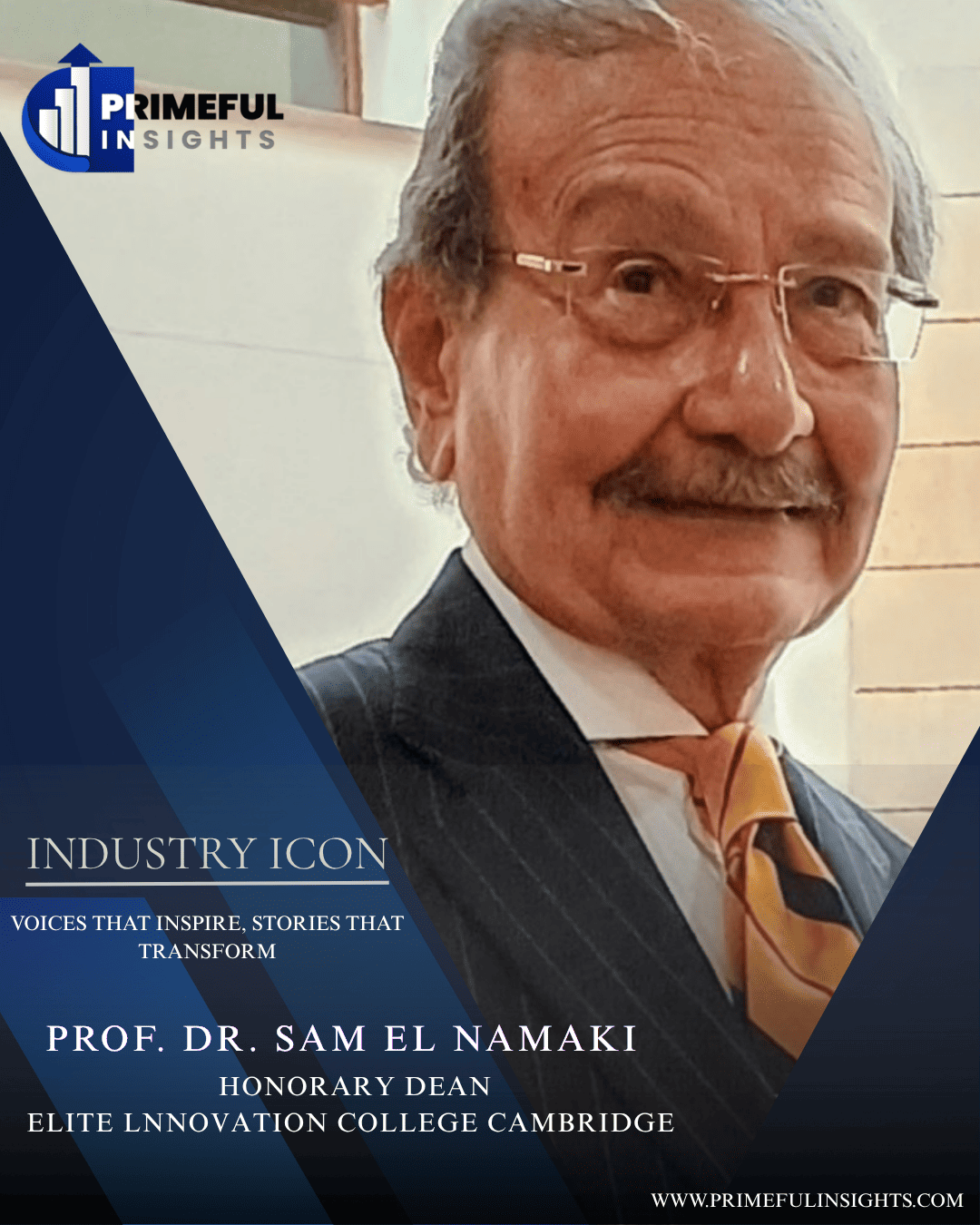
Thinking Beyond Boundaries: Prof. Dr. M. S. S. El Namaki’s Lifelong Quest to Understand the Future of Business and Society
Some individuals build careers. Others build institutions. A rare few shape the way entire generations think.
Prof. Dr. M. S. S. El Namaki belongs to the latter category.
Over a career spanning academia, consulting, strategic leadership, entrepreneurship, and global management education, he has consistently challenged conventional thinking about business, leadership, and organizational success. While many management experts focus on solving today’s problems, El Namaki has spent decades examining the forces that will shape tomorrow’s realities.
His work has taken him across continents, industries, and disciplines, but one theme has remained remarkably consistent throughout his journey: the belief that sustainable success depends on an organization’s ability to anticipate change before it becomes obvious.
As the former Founder and Dean of the Maastricht School of Management in the Netherlands and later Dean of the VU School of Management in Switzerland, he has influenced management education across Europe, Asia, the Middle East, and beyond. Throughout his career, he has developed MBA, DBA, EMBA, and doctoral programs in numerous countries while teaching and advising leaders across diverse cultural and economic environments.
Yet beyond the impressive titles and achievements lies something even more enduring: an insatiable intellectual curiosity.
A Career Defined by Curiosity
For El Namaki, management was never simply about administration or business performance. It was about understanding the deeper forces that shape organizations, economies, and societies.
His academic journey began with studies at leading institutions in Europe and executive education at MIT before evolving into a global career that combined teaching, consulting, and institution-building. Along the way, he held executive positions with major organizations, worked with multinational corporations, and advised governments and international institutions on strategic development and organizational transformation.
These experiences exposed him to vastly different business environments, yet they reinforced a common observation: organizations rarely fail because they lack resources. More often, they struggle because they fail to recognize emerging changes in time.
This realization became central to his philosophy.
Rather than focusing solely on operational excellence, he became increasingly interested in strategic foresight—the ability to understand future possibilities before they fully emerge.
For El Namaki, strategy has never been a static planning exercise. It is a dynamic process of sensing, interpreting, and adapting to an ever-changing environment.
Building Institutions, Not Just Programs
One of the defining chapters of his career was the creation and development of management education institutions that would influence thousands of future leaders.
As Founder and Dean of the Maastricht School of Management, he played a pivotal role in transforming the institution into an internationally recognized center for management education. Under his leadership, programs expanded globally, reaching emerging markets and helping develop business leaders in regions often overlooked by traditional educational models.
What distinguished his approach was a conviction that management education should not simply transfer knowledge. It should cultivate the ability to think critically, challenge assumptions, and navigate uncertainty.
He understood that business environments differ dramatically across countries and cultures. Therefore, effective leadership education required more than universal theories—it required contextual understanding, adaptability, and strategic awareness.
This global perspective continues to define his work today.
The Evolution of Strategic Thinking
Throughout his career, El Namaki has remained fascinated by the evolution of strategy itself.
Traditional strategic models were developed in relatively stable business environments where change occurred gradually and predictably. But today’s world operates differently.
Artificial intelligence, digital transformation, automation, data science, and rapidly shifting market dynamics have fundamentally altered how organizations compete and innovate.
Recognizing this shift, El Namaki began exploring how emerging technologies were reshaping the foundations of strategic management.
His more recent work focuses on the implications of artificial intelligence for organizational decision-making and leadership. In his book Neo Strategic Management, he argues that many traditional strategic concepts are no longer sufficient for navigating the realities of a technology-driven world. Instead, organizations must embrace new frameworks that integrate insights from fields such as psychology, neuroscience, cognitive science, and data analytics.
For him, the future of strategy lies not in rigid planning but in intelligent adaptation.
Embracing Complexity Instead of Avoiding It
A defining characteristic of El Namaki’s thinking is his willingness to explore complexity rather than simplify it.
Many business leaders seek straightforward answers to difficult questions. El Namaki takes a different approach. He believes that understanding complexity is essential to making better decisions.
Whether analyzing entrepreneurship, international business, innovation, or artificial intelligence, he consistently examines the interconnected relationships between systems rather than viewing challenges in isolation.
This systems-oriented perspective has enabled him to remain relevant across decades of dramatic technological and economic transformation.
It has also allowed him to bridge disciplines that are often treated separately.
His work increasingly explores the relationship between technology and human cognition, highlighting how advances in artificial intelligence are forcing organizations to rethink not only how they operate, but also how they learn, innovate, and make decisions.
The Human Dimension of Technology
Despite his enthusiasm for technological advancement, El Namaki remains deeply aware that technology alone cannot solve every challenge.
Throughout his writings, he emphasizes that successful organizations are ultimately driven by people—their creativity, judgment, adaptability, and capacity for learning.
Artificial intelligence may transform decision-making processes, automate tasks, and enhance analytical capabilities, but it cannot replace the uniquely human qualities that drive innovation and leadership.
This balanced perspective has become increasingly valuable as organizations rush to embrace new technologies without fully considering their broader implications.
For El Namaki, technology should serve human progress, not define it.
Its greatest value lies not in replacing human intelligence but in augmenting it.
A Lasting Global Impact
Over the years, El Namaki has published numerous books and more than one hundred articles covering topics ranging from entrepreneurship and strategic management to international business and emerging technologies. Several of his works have become influential teaching resources in management education worldwide.
His contributions have also been recognized internationally through prestigious awards, including distinctions from governments and institutions acknowledging his impact on education, leadership development, and international collaboration.
Yet perhaps his greatest impact cannot be measured through publications, awards, or positions held.
It can be seen in the countless students, executives, entrepreneurs, and educators whose thinking has been influenced by his ideas.
His work has encouraged leaders to think beyond immediate challenges and engage with larger questions about the future of business, technology, and society.
Looking Toward Tomorrow
Even after decades of contribution, Prof. Dr. M. S. S. El Namaki remains focused on the future.
He sees artificial intelligence, cognitive technologies, and data-driven systems not merely as technological trends, but as forces that will fundamentally reshape how organizations think, compete, and create value.
The challenge, he believes, is ensuring that leaders develop the intellectual agility necessary to navigate this transformation responsibly.
Tomorrow’s leaders will need more than technical expertise. They will need curiosity, adaptability, ethical judgment, and the ability to connect insights across disciplines.
These are qualities El Namaki has embodied throughout his own journey.
A Legacy of Intellectual Exploration
At its core, Prof. Dr. M. S. S. El Namaki’s story is one of continuous inquiry.
While many professionals spend their careers seeking certainty, he has spent his exploring possibilities. While others focus on immediate outcomes, he has consistently looked toward emerging horizons.
His legacy is not simply the institutions he built, the programs he launched, or the books he wrote.
It is the mindset he championed—a belief that progress begins with curiosity, that leadership requires foresight, and that the future belongs to those willing to question established assumptions.
In an age defined by disruption and uncertainty, that lesson may be more valuable than ever.